back
ABORA I
Experimentelle Seefahrt am Beginn der ABORA-Reihe

Goal
First major reed boat expedition along a fixed itinerary in 1999
Size
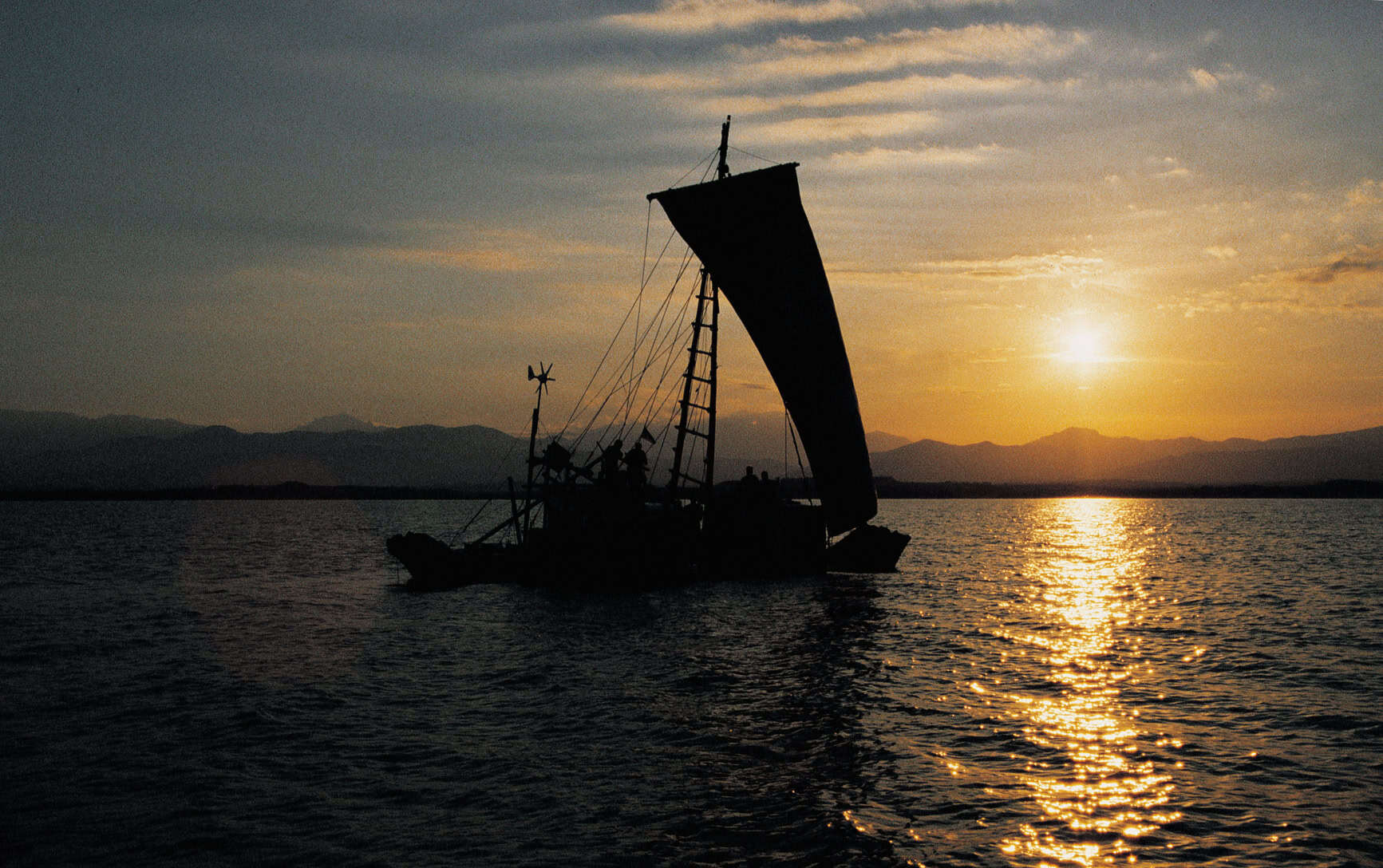
Length 14 m, width 4 m, weight 18 t, sail area approx. 49 m²
Material
Chinese silver grass
Sailing performance
Mittlere Segelfähigkeit ca. 100° quer zum Wind
Travel itinerary
from Sardinia to Elba, covering approx. 600 km
Objective & Research Question
The ABORA I expedition formed the starting point for the entire ABORA series. The aim was to conduct the first experimental tests in the Mediterranean to determine whether prehistoric cultures were capable of undertaking long-distance trade voyages using reed boats equipped with side swords.
The central question was whether reed boats are fully controllable and maneuverable enough to navigate outside protected coastal waters.
The starting point was new rock art findings from Upper Egypt (Negade culture), on which Dominique Görlitz had already discovered side swords on sail-equipped reed boats in 1992. The discovery had already been successfully tested in preliminary experiments on smaller reed boats (DILMUN II to III).
Construction & Engineering
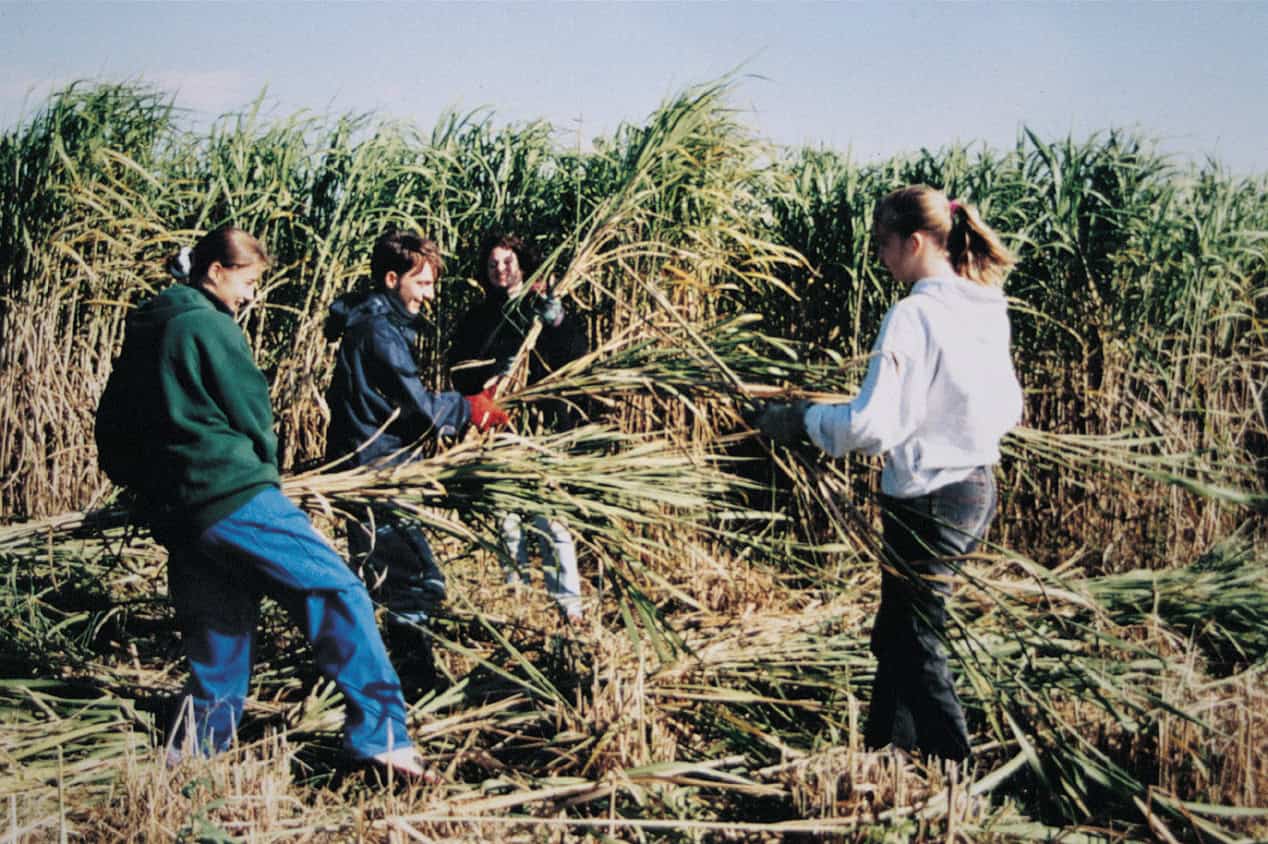
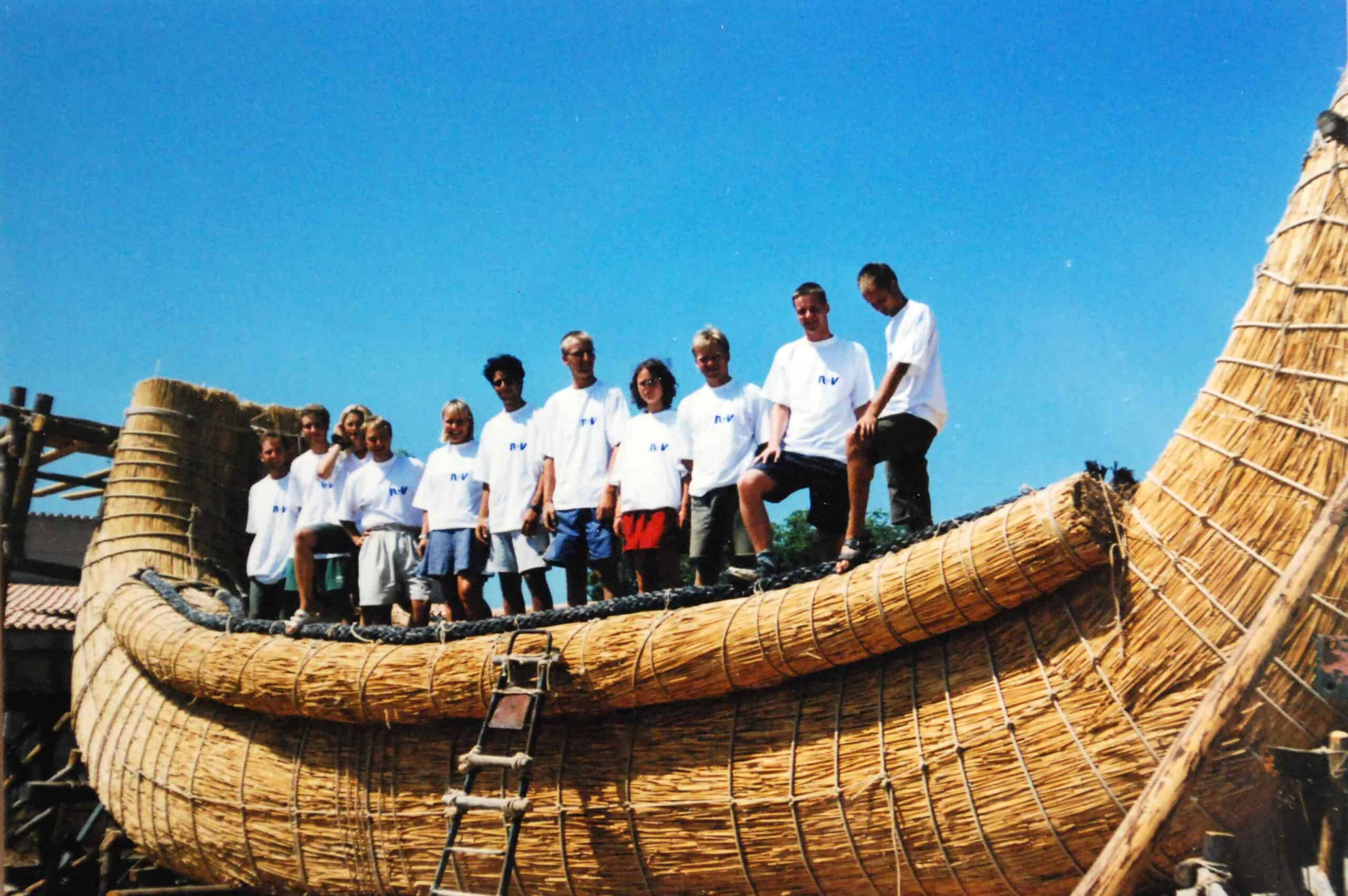
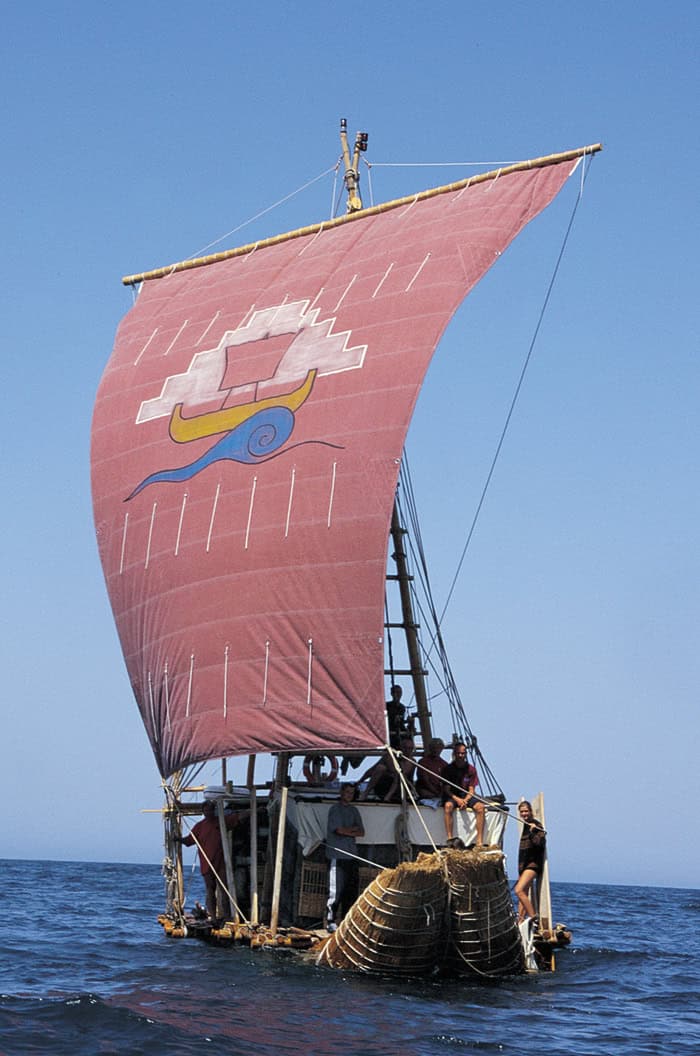
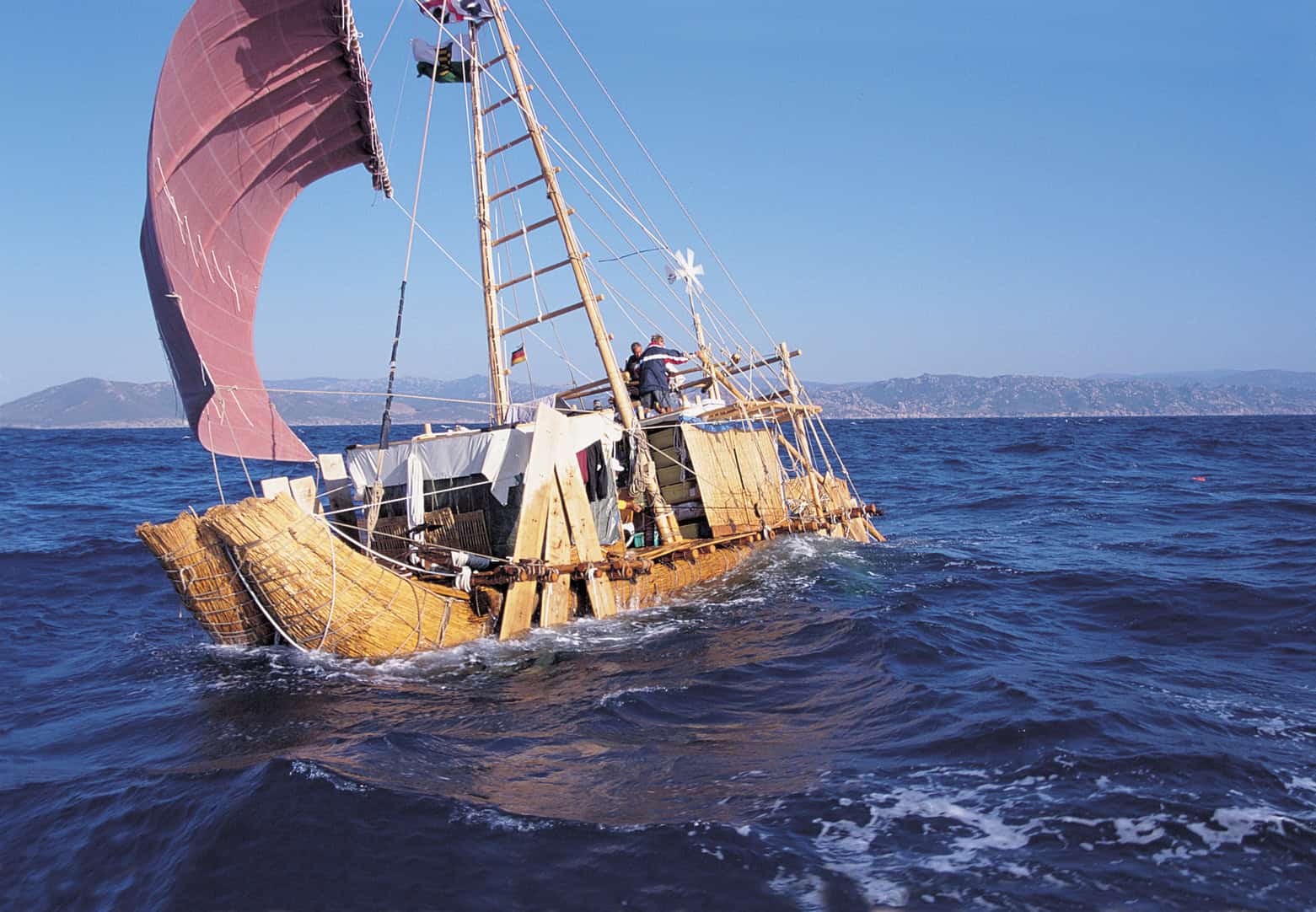
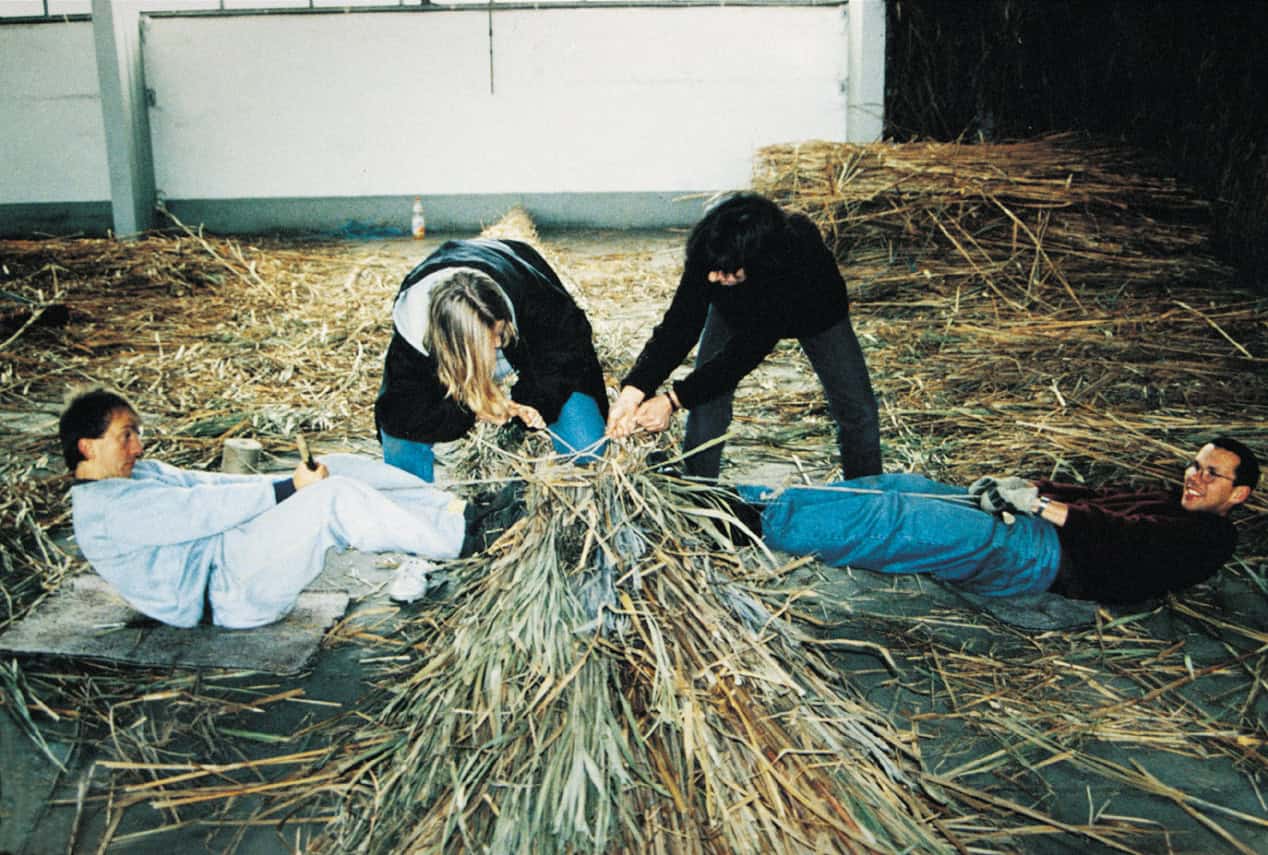
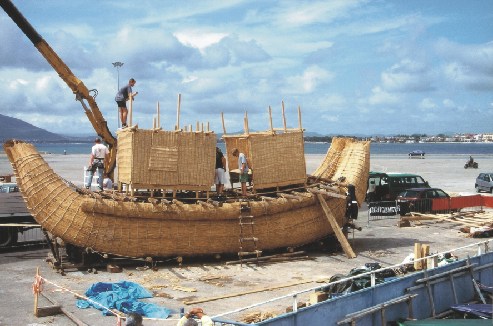
ABORA I was built as a reed boat using traditional construction methods. The construction was based on historical and ethnological models from various cultures, particularly from regions where reed boats were used until recently. These include, in particular, the reed boats from Lake Titicaca and Sardinia.
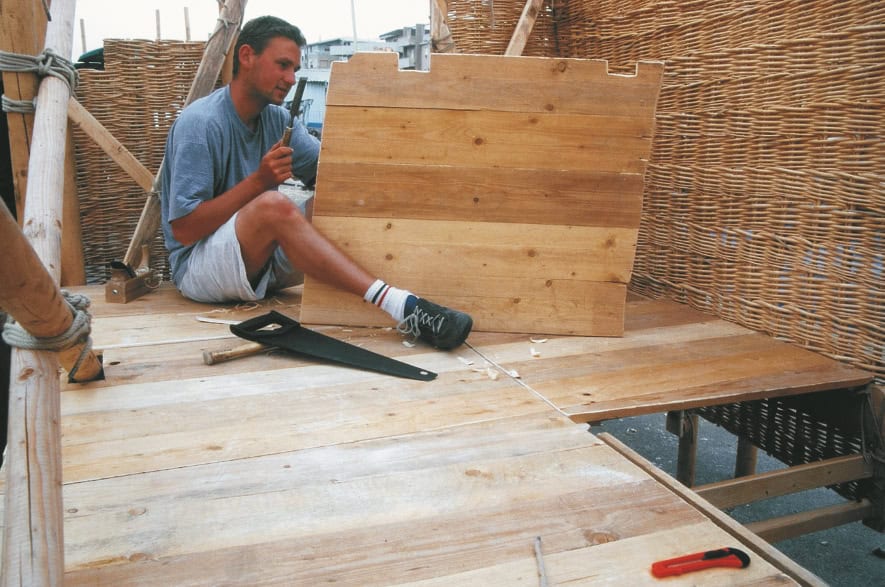
The construction was carried out entirely without modern materials or technical aids. It was realized by students from the “Am Breiten Teich” high school in Borna and graduates of the former Alexander von Humboldt high school in Chemnitz from 1997 to 1999 near Fertilia in Sardinia. Only the following materials were used:
- Chinese silver grass (Miscanthus sinensis L.), family of sweet grasses (Poaceae)
- simple wood and rope constructions
- side swords made of low-quality poplar wood
- a sail, made for the first time from high-quality imitation hemp and with a sail area of 56m²
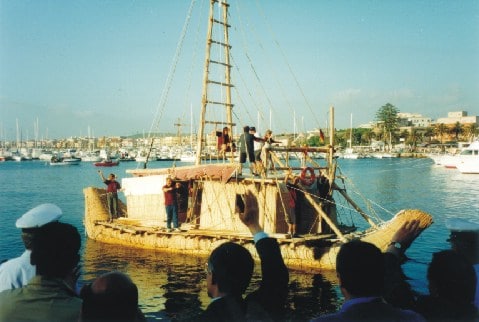
In 1999, the sailing raft was rigged and launched in the nearby town of Alghero. Both the construction and the subsequent expedition were
documented by Terra X/ZDF.
Route & Implementation
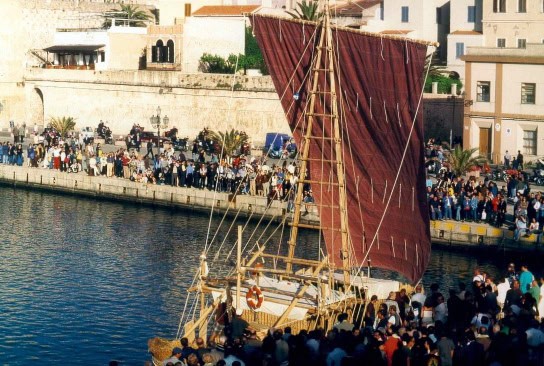
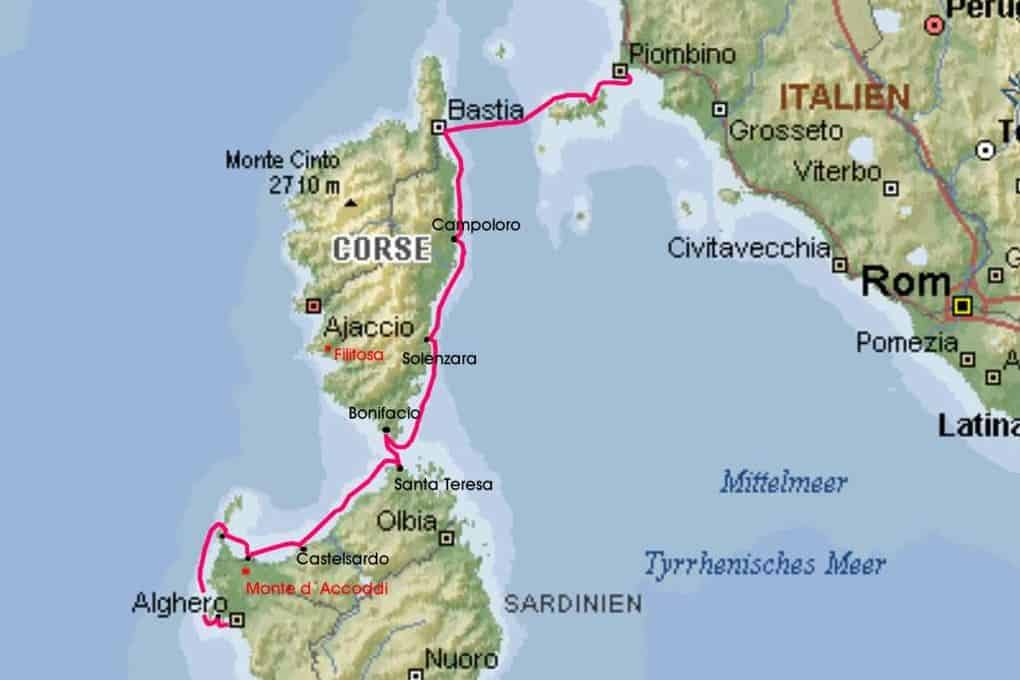
The expedition started in Alghero and was originally supposed to sail directly across the western Mediterranean towards the Atlantic (Canary Islands). A constant lack of funds and legal restrictions imposed by the Alghero port authority led to considerable delays. In addition, test sailing revealed that, unlike the DILMUN III, the ABORA I was not able to sail very close to the wind. The ABORA I was unable to sail more than half-wind courses.
For this reason, the expedition leader decided to change the route. Instead of sailing directly to the western Mediterranean, they took a detour eastward around Corsica so that, in case of emergency, they could bring the first major experiment (supported by Touri Sardo) to a controlled end in Piombino (southern Tuscany).
During the journey, the following aspects, among others, were tested:
- Buoyancy and long-term flotation of Chinese silver grass
- Controllability with four bow and three stern rudders
- Load-bearing capacity of the material, including superstructures
- Boat behavior during prolonged contact with water
The crew gained extensive practical experience in handling the reed boat.
Significance & Results
ABORA I was able to show that:
- a boat built entirely from reeds is seaworthy
- longer journeys are possible even in changing weather conditions
- Unlike the DILMUN rafts, the mast was positioned too far in the center, which caused the sailboat to be too windward.
Nevertheless, ABORA I provided experimental proof that early cultures had the technical capabilities to sail along a predetermined route and thus navigate to distant trading partners. Archaeologically, this hypothesis is supported by obsidian finds from Monte Archi (Sardinia) across the Tyrrhenian Sea to Central Europe.
Classification within the ABORA series
ABORA I was not an end point, but rather the beginning of a systematic series of research projects.
The insights gained were directly incorporated into the planning of subsequent expeditions:
- Improvements in construction
- more precise questions
- Extension to specific historical sea routes
Without ABORA I, the later, significantly more ambitious ventures ABORA II–IV would have been inconceivable.
Significance for classical studies
The ABORA I expedition represents a fundamental contribution to experimental maritime archaeology. For the first time, tests were conducted under real conditions to determine whether a prehistoric reed boat reconstructed with the aid of leeboards could be maneuvered not only near the coast but also on open sea routes.
ABORA I showed that early boat constructions made from organic materials had a structural stability that had previously been underestimated. This put into perspective the widespread assumption that prehistoric seafaring was limited to short distances and calm waters.
The expedition provided important empirical data on:
- Seaworthiness of reed boats,
- Effectiveness of side swords,
- and on the fundamental controllability of such vehicles under changing wind conditions.
ABORA I established a new methodological approach: combining archaeological rock art research with practical deep-sea testing proved to be a suitable tool for making maritime hypotheses in ancient studies verifiable not only theoretically but also experimentally.