back
Subproject II
The Cheops Project – The Cheops Scandal
As part of the regular ABORA congresses, which took place in collaboration with Galileo Park Lennestadt and Nuoviso TV, Dr. Dominique Görlitz and Stefan Erdmann publicly presented their initial findings from the archaeometric investigations in the Pyramid of Cheops. The combination of images, film documentaries, and scientific explanations led to the rapid dissemination of the content—far beyond the actual specialist community.
Among the external observers was Osama Karar, press spokesperson for the Egypt’s Heritage Task Force. However, Karar misinterpreted the publicly available media and mistakenly assumed that illegal sampling had taken place inside the Great Pyramid. Instead of contacting the responsible Egyptian authorities, he informed Zahi Hawass, who at that time had already been removed from office as Minister of Antiquities. This false assumption became the starting point for an escalation that ultimately culminated in one of the largest scandals in recent archaeological history.
Within a very short time, the allegations initially spread through Egyptian media and shortly thereafter internationally. As a result, the Cheops Project became increasingly caught in a vortex of archaeological, media, and political interests. On 10 December 2013, Zahi Hawass decisively intensified the situation with a publication in the daily newspaper Al Masry Al Youm. In it, he accused Görlitz and Erdmann, among other things, of having stolen the Cheops cartouche on behalf of the Belgian pyramid researcher Robert Bauval. He also claimed that the researchers had sought to prove that the inscription was 15,000 years old—a claim that was neither part of the study nor ever advocated by those involved.
Hawass further spoke of “vandalism” and a “criminal break-in into the pyramid.” These accusations marked a turning point: the scientific findings—particularly the evidence of iron residues in the King’s Chamber—were pushed entirely into the background. From that point on, the so-called Cheops scandal dominated public perception.
A complete description of all developments would go beyond the scope of this website. They are documented in detail in the book “Das Cheops-Projekt” (2016). At this point, three central aspects should be highlighted.
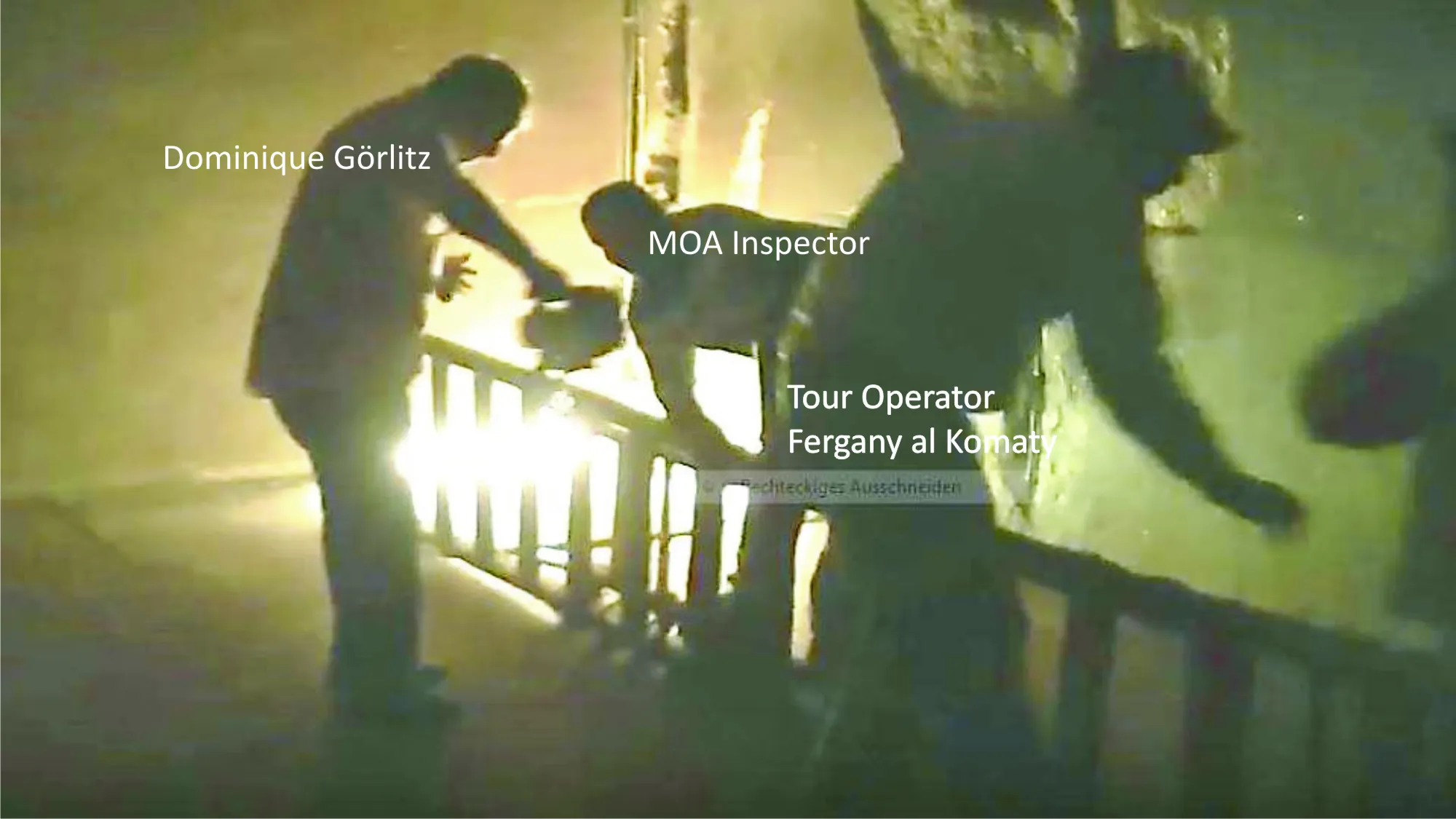
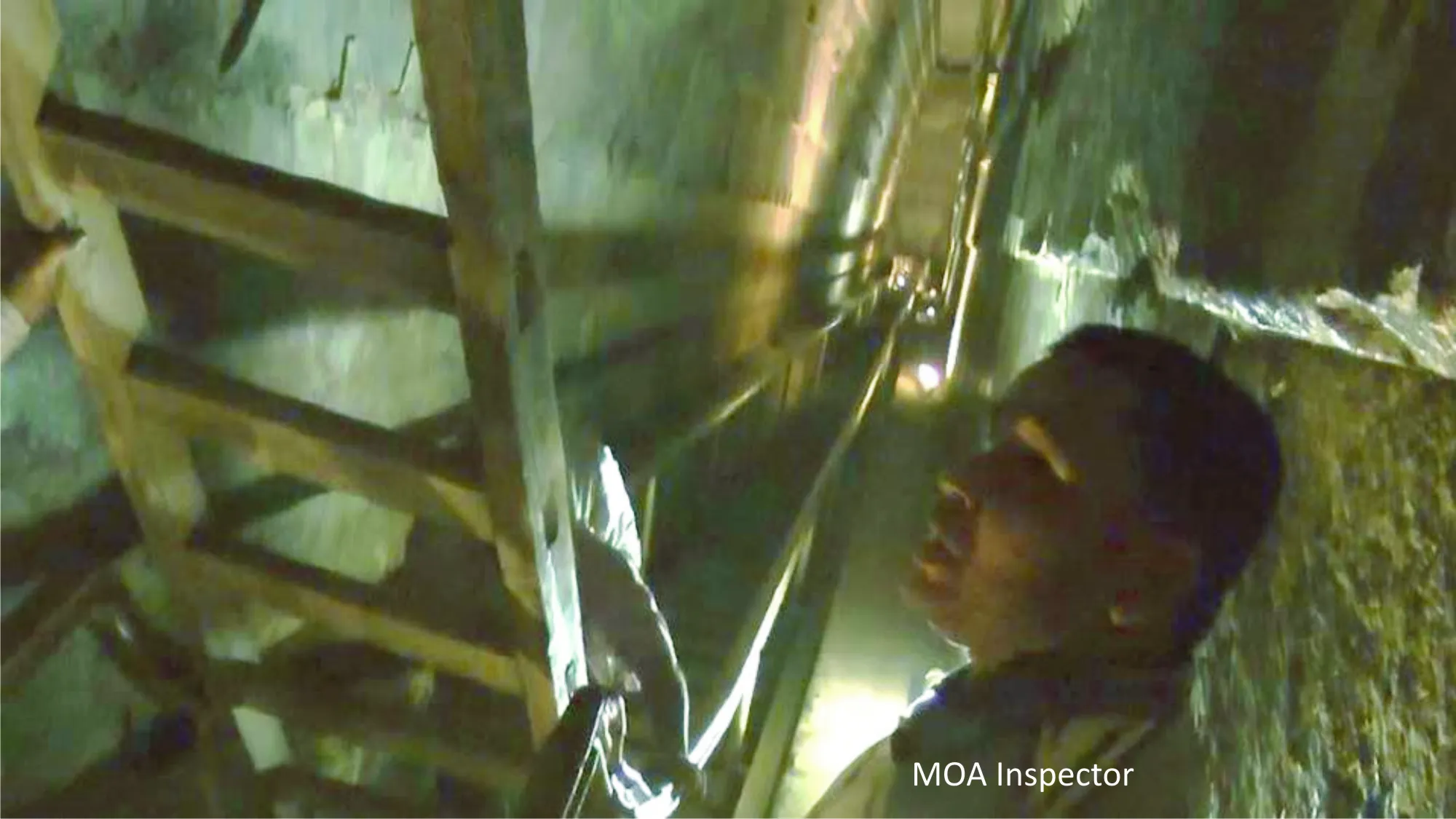
These pictures document that the inspectors actively supported us in climbing into the relief chambers. Hawass' accusation of criminal burglary and theft is thus refuted. Our research was registered and we were supervised by three experienced Egyptologists.
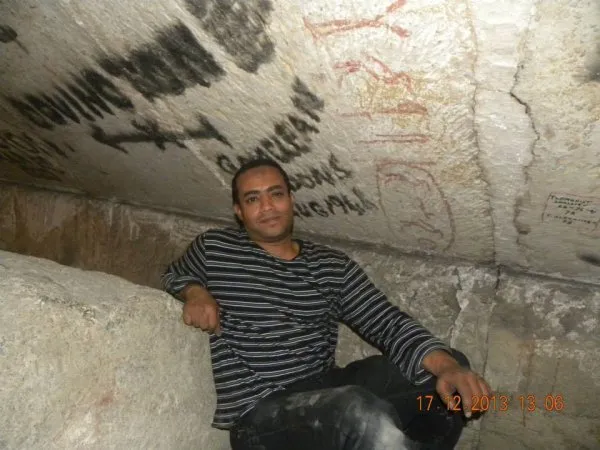
On December 17, 2013, an investigative commission from the Antiquities Authority climbed into the uppermost relief chamber. The aim was to assess the damage to the Cheops cartouche. The inspector pictured here found four clear chisel marks on the edge of the Cheops cartouche.
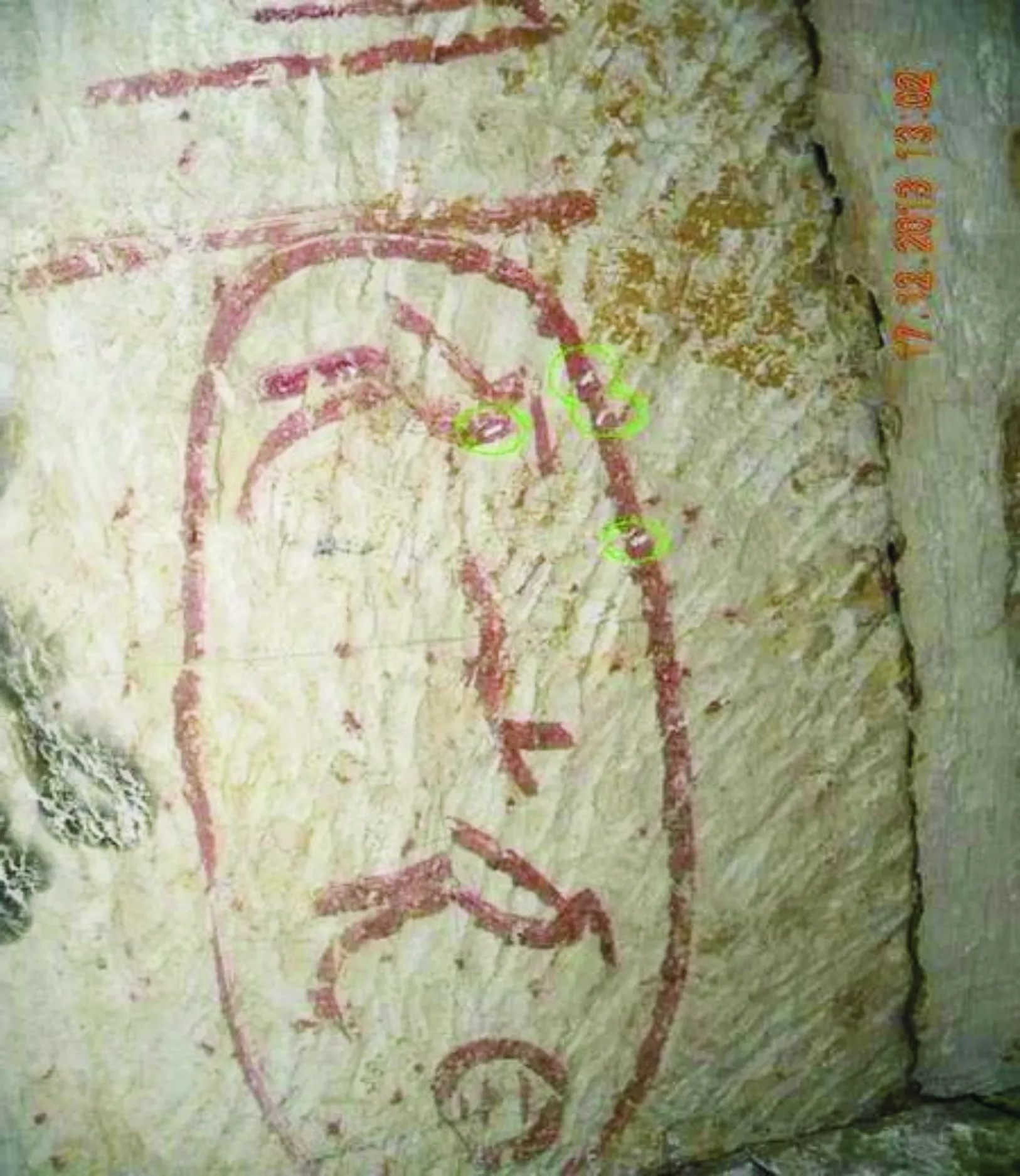
This photo (right) destroyed any hope of an amicable settlement in the Cheops scandal. The four green circles mark the damage we allegedly caused to this cartouche...
1. The attempt at immediate clarification
Immediately after the allegations became known, Dominique Görlitz contacted the renowned Egyptologist Ahmed Osman, who put him in touch with the acting Minister of Antiquities, Mohamed Ibrahim. All permits, procedures, and analysis results were disclosed in discussions. At first, this approach seemed to be successful.
Our apology was also published via the state news agency MENA. On 27 December 2013, an official statement by the Ministry appeared in the Egyptian Independent under the headline: “German archaeologists will not be punished for stealing the Cheops artifacts.” In this statement, Minister Ibrahim explained that while there had been irregularities in the permit procedure, these were on the Egyptian side. At the same time, he publicly reprimanded Hawass and suggested that events had taken place in the Great Pyramid under Hawass’s responsibility in 2006 that were known. The full significance of this statement only became clear later.
Dr. Dominique Görlitz received crucial assistance from Prof. Robert Schoch in the form of two photos of the Cheops cartouche from 2003 and 2006.
2. The role of external peers
The accusations also led to initial personal contact between Görlitz and Robert Bauval, one of the most renowned independent pyramid researchers. After a clarifying discussion, Bauval pledged his support. He arranged contact with Prof. Robert Schoch (Boston University College), who provided images of the Cheops cartouche from 2003 and 2006.
The joint evaluation showed that the chisel marks allegedly caused by Görlitz must have been present before 2013, namely by 2006 at the latest. Minister Ibrahim had previously indirectly referred to precisely this period. Despite joint press releases and public statements, however, the escalation could no longer be stopped.
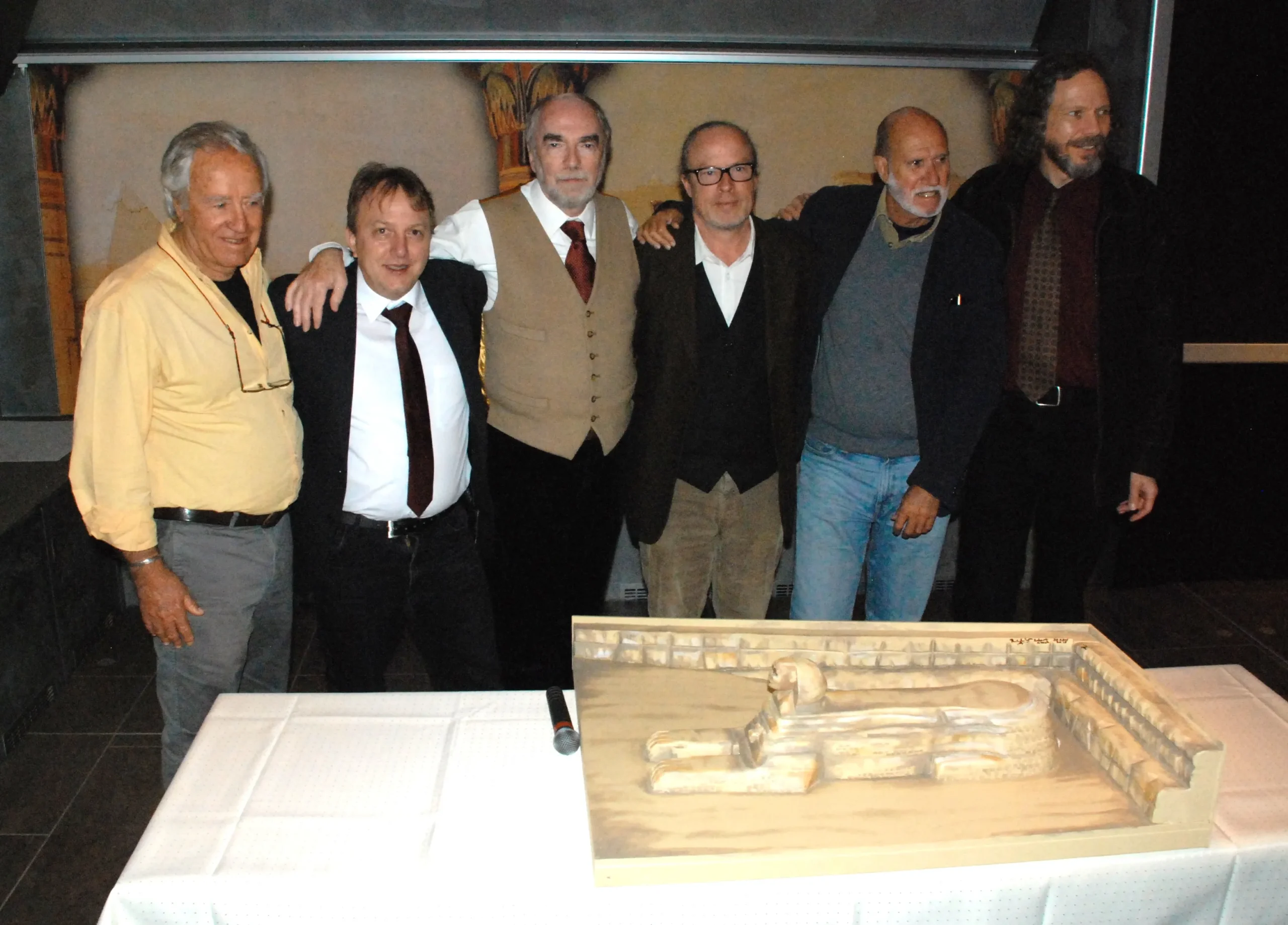
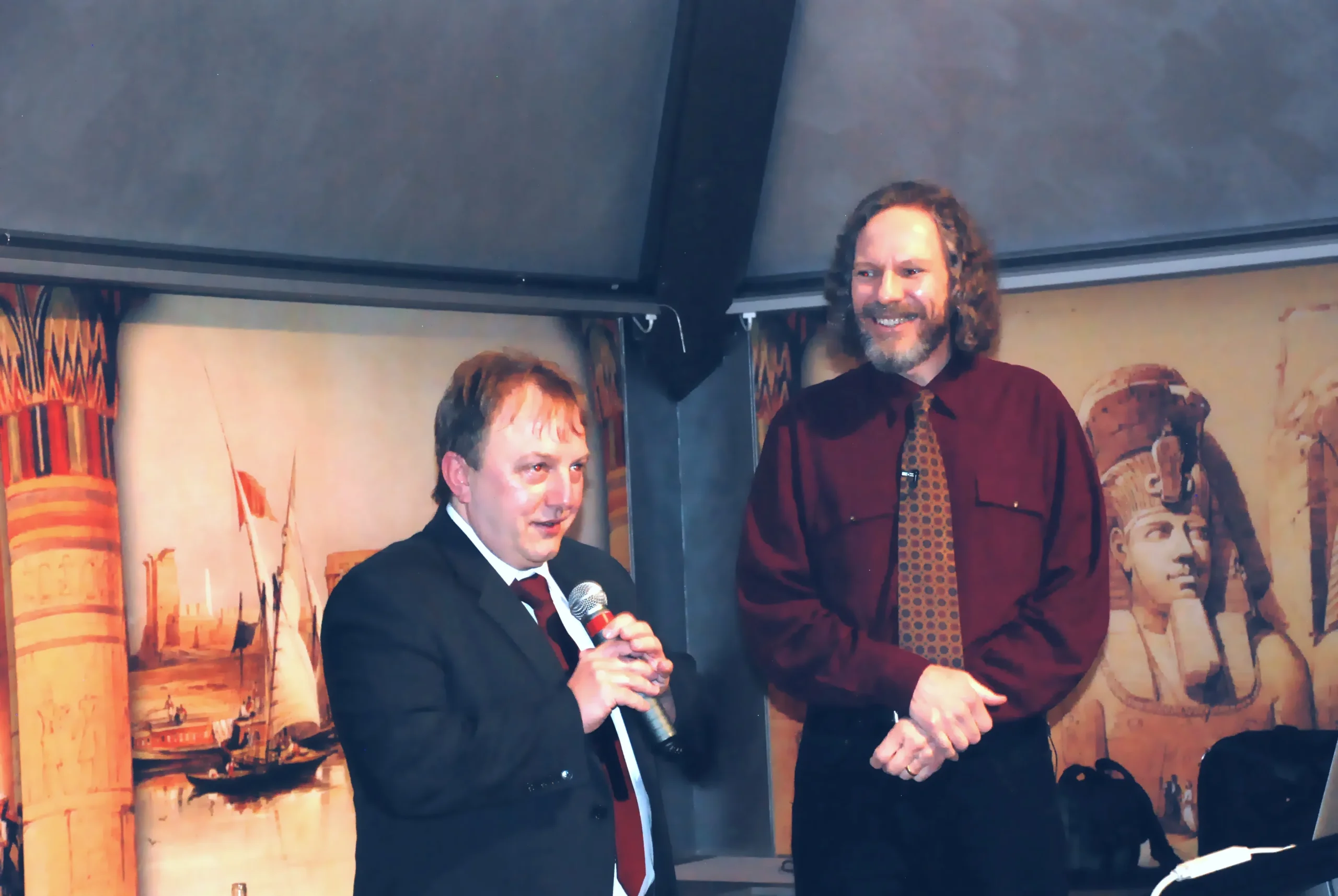
All of Dominique Görlitz's supporters gathered at the 2nd Cheops Congress in Lennestadt:
(from left to right) Jean-Paul Bauval, Dr. Dominique Görlitz, Prof. David Rohl, Stefan Erdmann, Robert Bauval, and Prof. Robert Schoch.
3. Legal implications and personal consequences
The situation culminated in criminal proceedings in Egypt. Nine Egyptian and three German participants were sentenced to five years' imprisonment in the first instance. This was followed by serious personal and professional consequences: the termination of an ongoing habilitation procedure at the Technical University of Dresden, expulsion from the Explorers Club New York, the end of cooperation with ZDF, and further public defamation. Görlitz and Erdmann were also issued with an Interpol Red Notice. This led to temporary arrests in Oman (Görlitz) and Croatia (Erdmann).
The only way to resolve this situation was to pursue legal proceedings in Egypt. With the support of Egyptian lawyer Shaheen Hamed, Görlitz in particular conducted two extensive trials. First, in 2016, the six Egyptian colleagues were acquitted of the charges of involvement – after some of them had spent several years in prison. In the first appeal proceedings in 2017, it was recognized that the work had been a scientific study and not a criminal act. The Interpol search was then lifted.
A second appeal, which was only concluded in 2021, served to fully rehabilitate Görlitz with regard to the remaining allegations. The legal proceedings lasted more than five years and cost around €80,000.
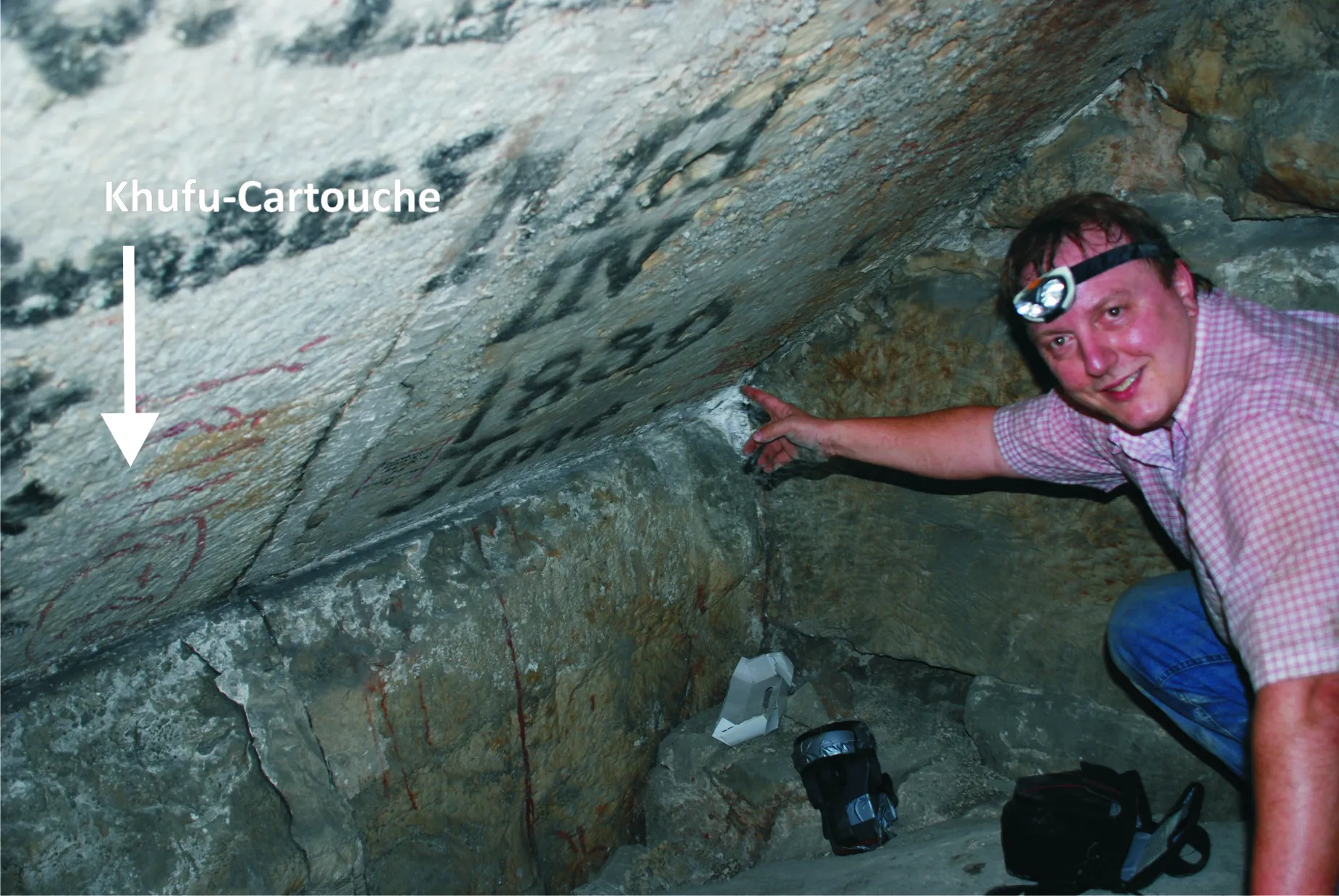
This photo supports Görlitz's claim:
The white arrow (left) marks the location of the Cheops cartouche. Görlitz points to the corner on the right, where he sampled an insignificant painting. He had discussed this beforehand with the inspector from the antiquities authority.
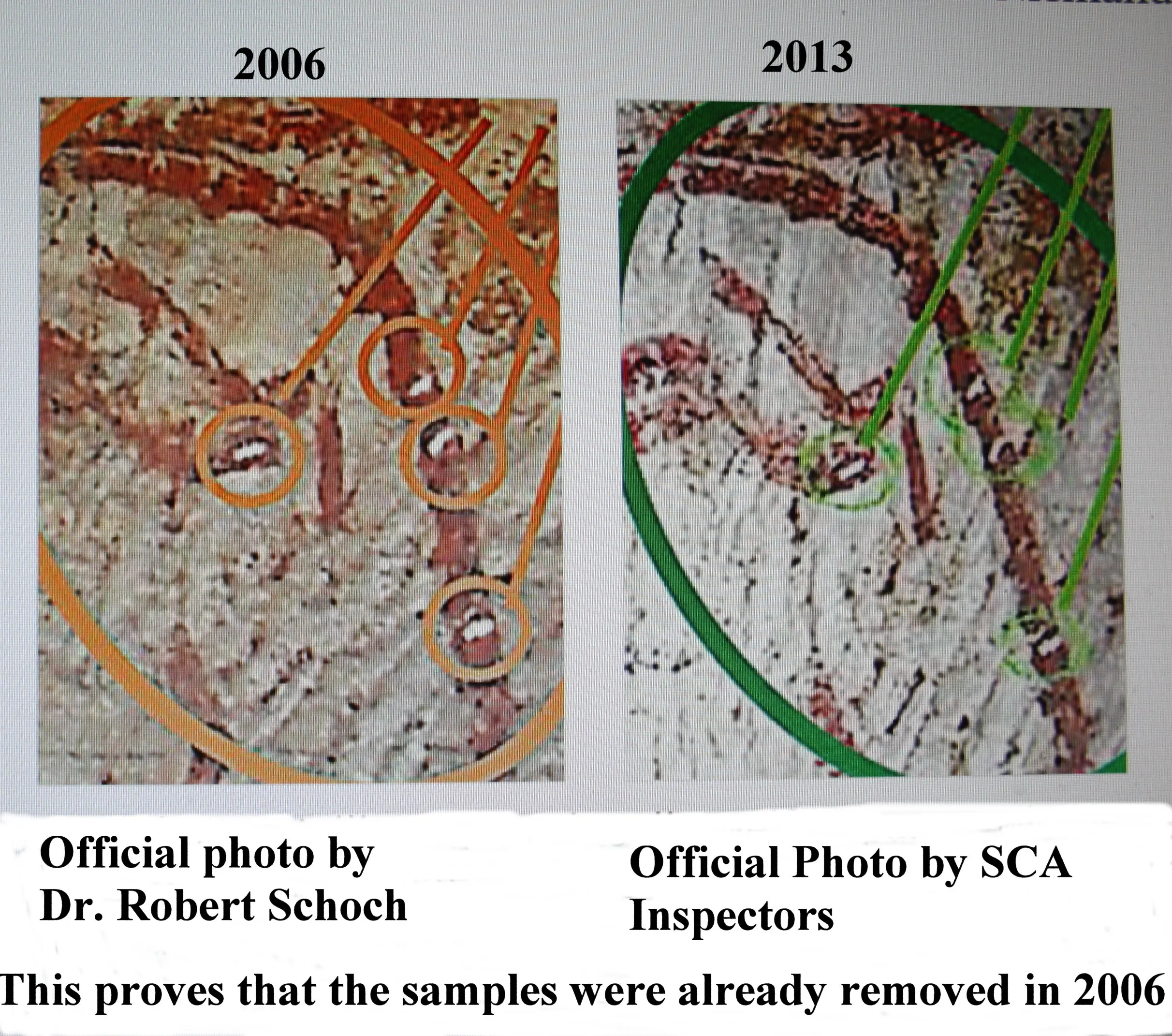
Two edited photographs of the damaged cartouche from 2006 and 2013: on the left, the photograph by Prof. Robert Schoch. On the right, the photo from the Antiquities Authority. The circles on both images prove categorically that the damage is exactly the same. Question: Who knew about these unofficial samples? And why was this not communicated by the authority under Hawass in 2006? Why were we blamed for this damage to the cartouche in 2013?
Conclusion of the scandal
The Cheops scandal exemplifies the risks that citizen science exposes itself to when dealing with iconic monuments. Misinterpretations, media dynamics, and political interests at times completely overshadowed the scientific facts. It took years of legal proceedings to refute the key allegations. With the Interpol measures lifted, Dominique Görlitz was finally able to continue his research—and, among other things, prepare for the ABORA IV expedition.