back
DILMUN III
First tacking against the wind

Goal
Improving leeboard sailing technique
Size
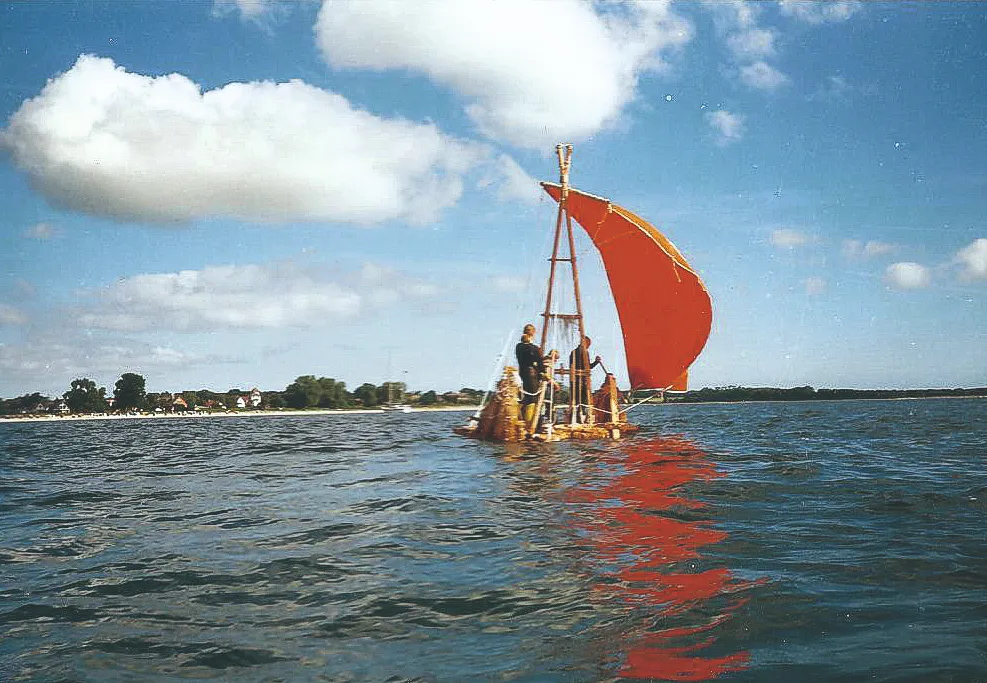
Length 6 m, width 2 m, weight 1.5 t, sail area approx. 20 m²
Material
European reed
Sailing performance
For the first time, courses upwind (approx. 70° to the apparent wind)
Field of application
Baltic Sea at the Kiel Fjord, Schilksee
Objective
DILMUN III marked the decisive transition from controlled inland waterway trials to open sea operations. Following the successful sea trials with leeboards on the Wangenheim reservoir, the goal was now to verify the newly acquired knowledge under real maritime conditions.
The central question for the first time was whether a reed boat, equipped with simple, archaeologically documented steering aids, could manage not only beam reaches but also actively tacking against the wind. This was intended to test one of the most fundamental assumptions of maritime archaeology: the thesis that prehistoric reed boats were exclusively limited to downwind or drifting voyages.
The experiment was first documented by SAT1.
Preparation and further development
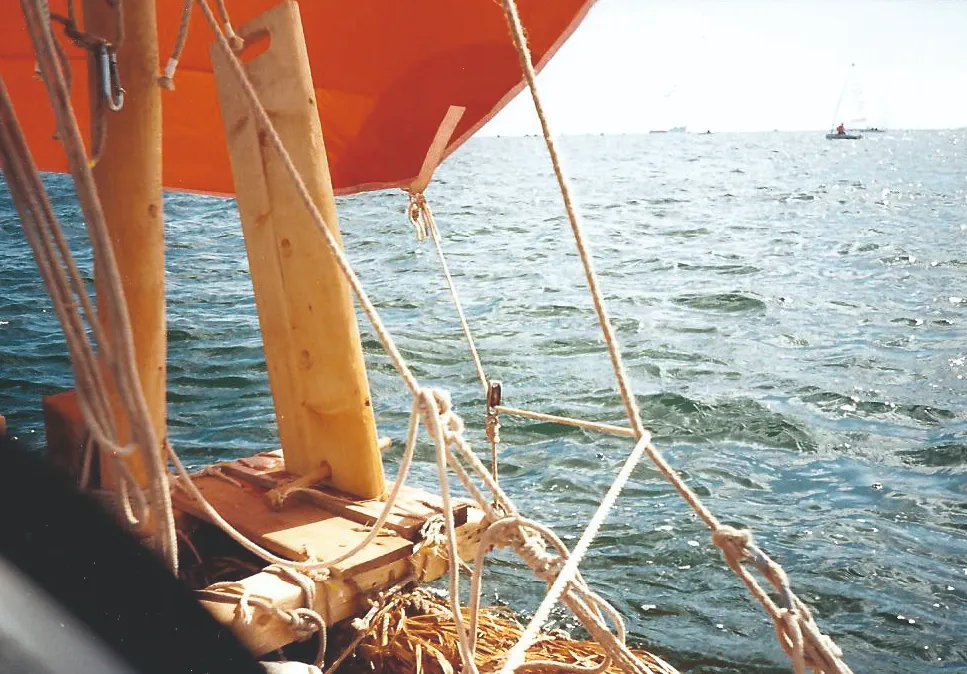
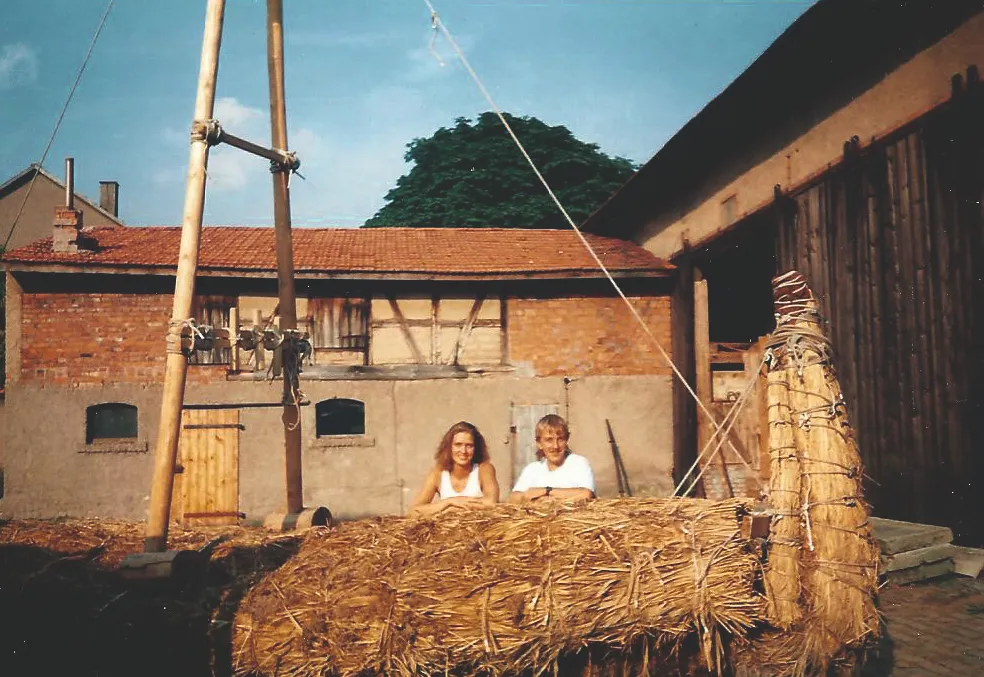
The basis for this was the still well-preserved DILMUN II boat, which was first conserved and then reinforced in the hometown of Dominique Görlitz Hochheim with an additional layer of reeds. The aim was to increase the structural stability for use at sea without significantly altering the proven hull shape.
The leeboards were further optimized in terms of their position and handling. In particular, the experience gained from the sea trials on the reservoir – the consistent placement of the leeboards on the leeward side – was now specifically incorporated into the preparation. Mast position, sail profile, and trim were consciously considered as an integrated system for the first time.
DILMUN III was therefore no longer an improvised experiment, but the result of a learning development process.
Testing on the Baltic Sea
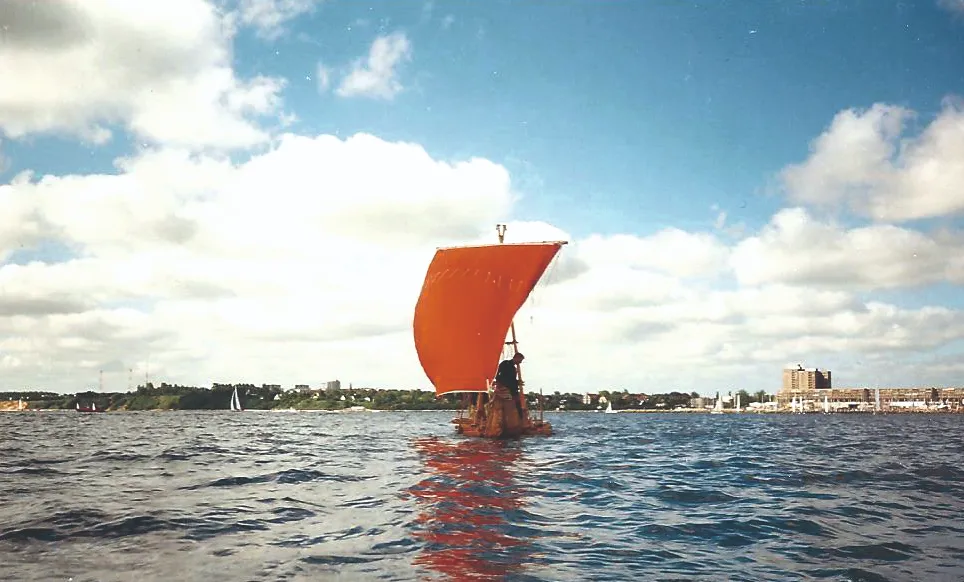
The opportunity for the first major test arose in 1994, when Dominique Görlitz and his crew were invited to the 100th Kiel Week. The Schilksee Olympic harbor became the starting point for the first offshore trials of a DILMUN reed boat.
The Baltic Sea presented the experiment with entirely new challenges: changing wind directions, choppy seas, strong currents, and heavy shipping traffic. But it was precisely under these conditions that the potential of the new design became apparent.
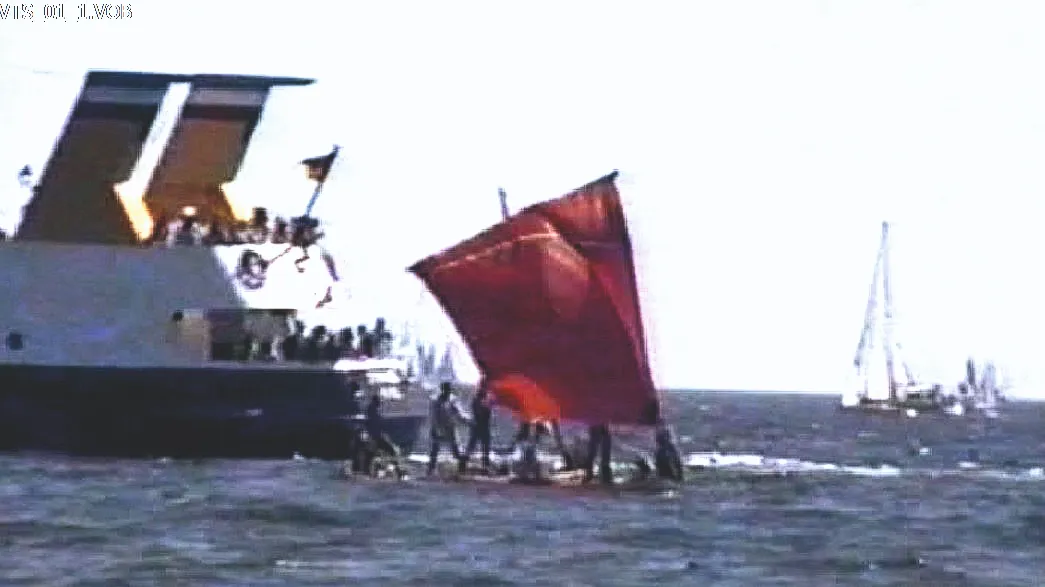
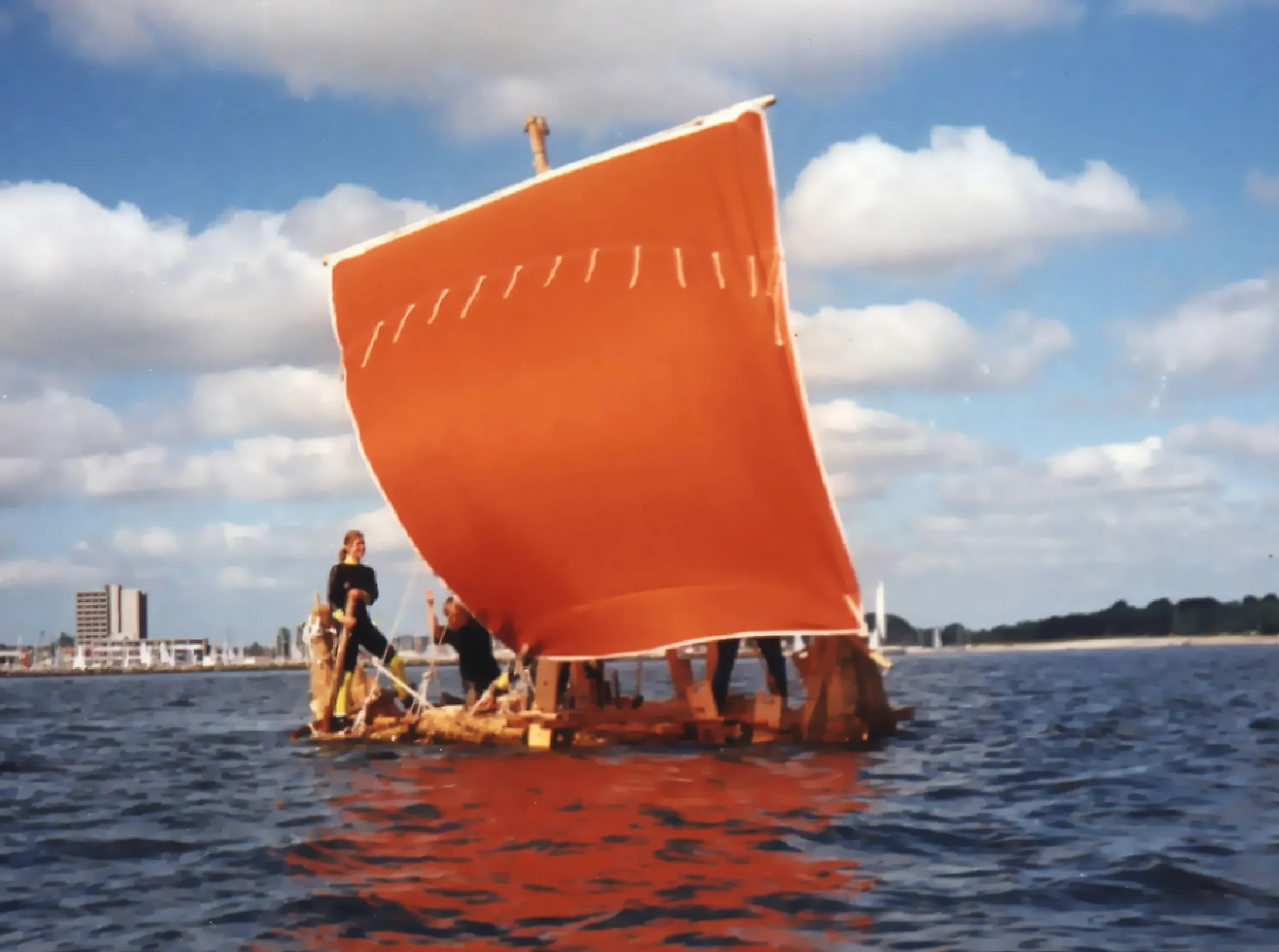
For the first time, it was possible to tack the reed boat in a controlled manner against the wind. Through repeated tacking and the deliberate use of leeboards, DILMUN III was able to gain windward progress—a manoeuvre previously considered practically impossible for reed boats. Particularly impressive was an incident in strong winds (wind force 7), when the water police stopped the experimenters while en route toward Strande and ordered them back to Schilksee. ihrer On the return leg, they passed a ferry whose flag at the stern indicated the wind direction. A firefighter from Frankfurt am Main filmed the encounter at sea. On the Hi8 tape, Görlitz later observed after Kiel Week how remarkably close to the wind DILMUN III had been sailing back toward Schilksee. Subsequent measurements on the nautical chart showed a course of approximately 70° off the apparent wind.
Results and findings
Görlitz could not have imagined this result at the beginning of his DILMUN work. After reading Heyerdahl's books and conducting preliminary experiments with DILMUN I & II, he believed that beam reach courses were the optimum that sailed reed boats were capable of. DILMUN III had shown for the first time that the archaeologists' paradigm was incorrect: that Neolithic colonists only maneuvered downwind der from landing place to landing place under the supposed protection of the coast.
DILMUN III delivered an experimental breakthrough. For the first time, it was demonstrated under real sea conditions that:
- Reed boats can actively gain height upwind,
- Simple side swords are sufficient to enable crossing,
- and the combination of hull shape, sail trim and lateral surfaces forms a complete sailing system.
This empirically refuted a key argument against early deep-sea voyages using organic boats. DILMUN III showed that prehistoric seafarers – given the appropriate knowledge – were not at the mercy of the wind, but could have been capable of targeted navigation.
The paramount importance of DILMUN III
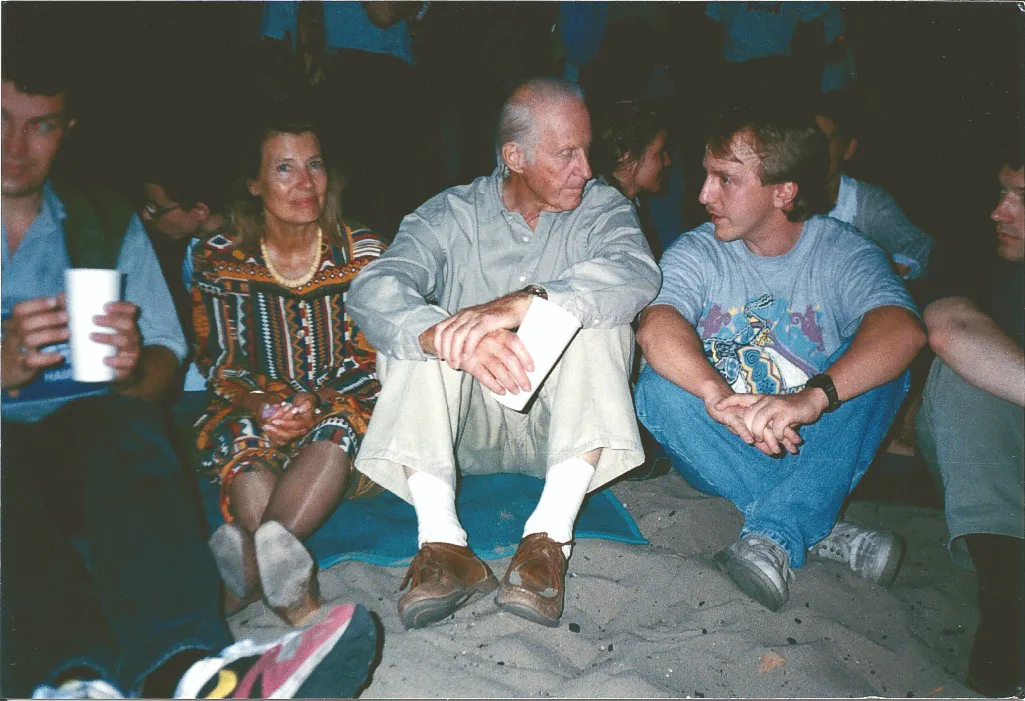
Görlitz sent the video recordings of DILMUN III, as with the first two projects, He was motivated by the hope of receiving a response, which had so far never materialized. With the Kiel footage, however, things were to be different. Less than five weeks later, none other than Thor Heyerdahl contacted him with an invitation to Tenerife. The first meeting, after an initial failed attempt, finally took place in spring 1995 in Güímar . Thor Heyerdahl and his wife Jacqueline Beer took an entire day to welcome Conny and Dominique at the Pyramiden Park of Güímar and on their Finca Mora. In several hours of conversation, Dominique—rather than Thor—taught his great role model how to navigate a prehistoric reed boat against the wind.
That was the birth of the ABORA-project.
between DILMUN III and ABORA I: The Einbaum-project