back
Einbaum-Experiments –
Between DILMUN III and ABORA I
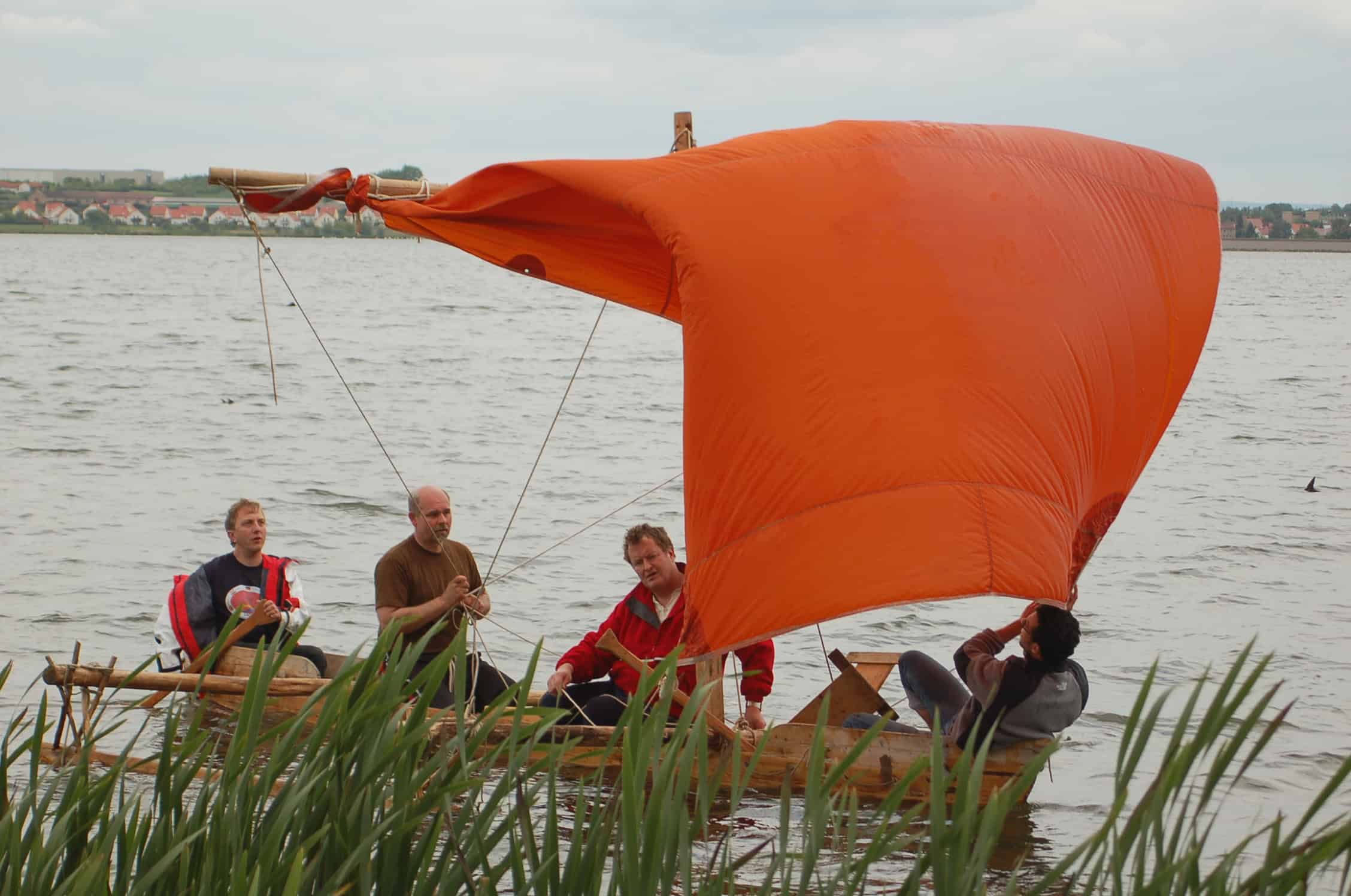

Goal
Experiences with sailed dugout canoes
Size
Length 6 m, width 0.5 m, weight 150 kg, sail area approx. 4 m²
Material
European poplar and spruce
Sailing performance
Courses up to half close-hauled (90°)
Field of application
Wangenheim Reservoir, Baltic Sea at Greifswald Bodden and rivers
Dugout canoe and pirogue experiments
Following DILMUN III and Dominique Görlitz's departure from Friedrich Schiller University Jena, the experimental research was not discontinued but continued in a new form. With his new teaching position in Chemnitz, the focus of the practical experiments shifted to the school setting.
Together with students from the Alexander von Humboldt Gymnasium in Chemnitz, two large dugout canoes were built between 1995 and 1996 at the former Chemnitz School Biology Center (now the Chemnitz Botanical Garden). The aim was to experimentally investigate a second archetypal type of vessel alongside the reed boat: the dugout canoe, which is one of the oldest watercraft in the world.
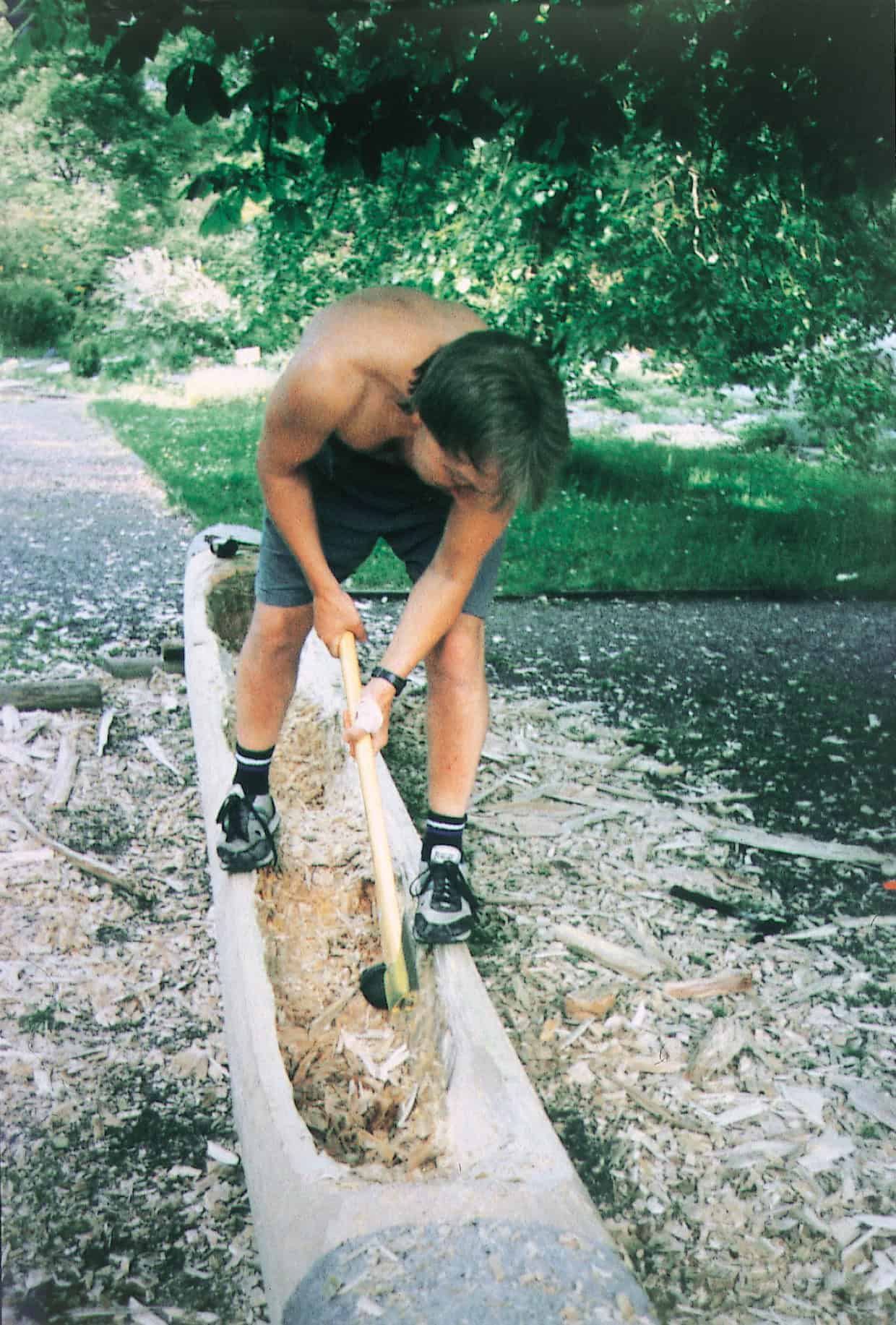
Construction and further development
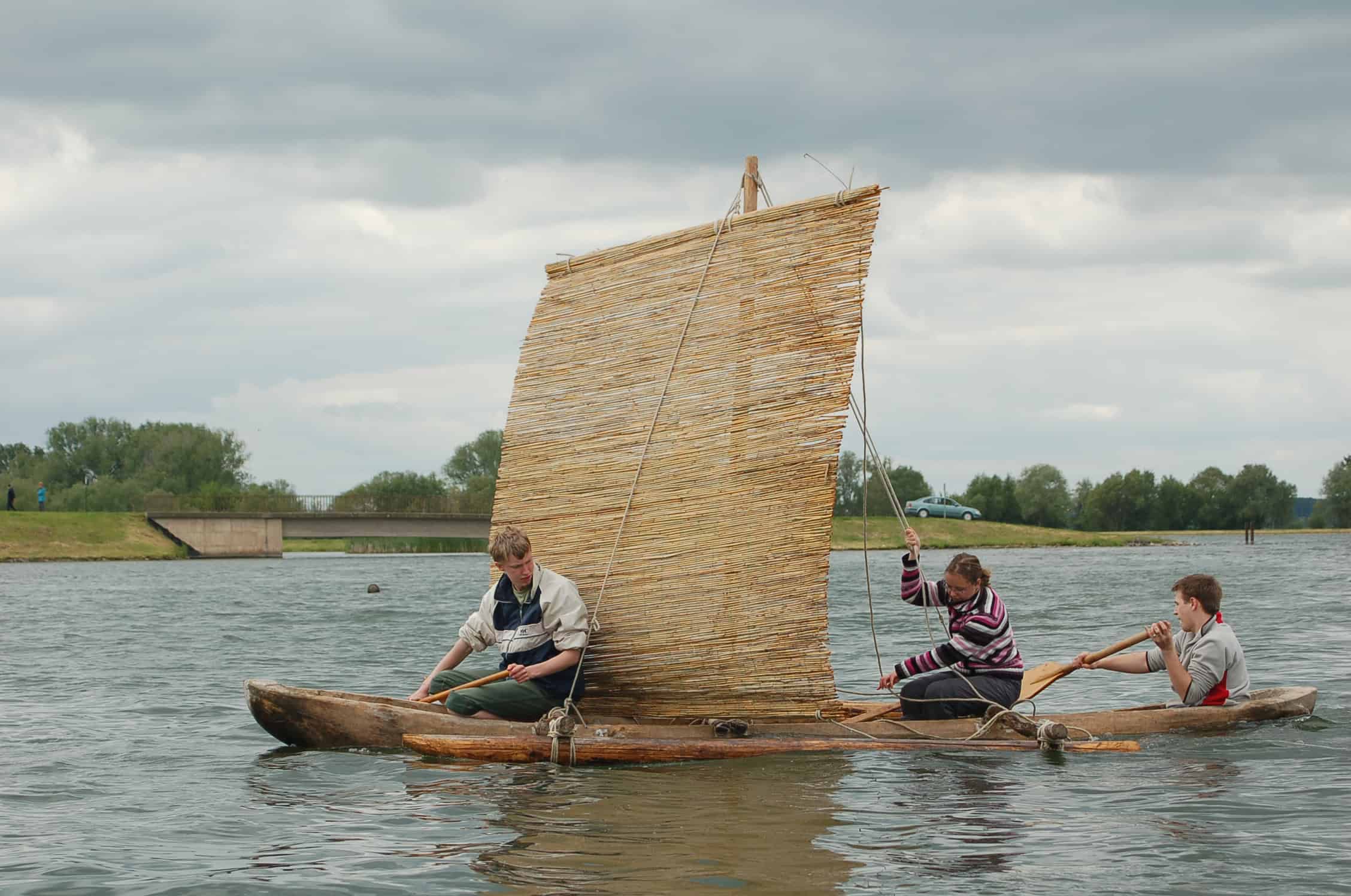
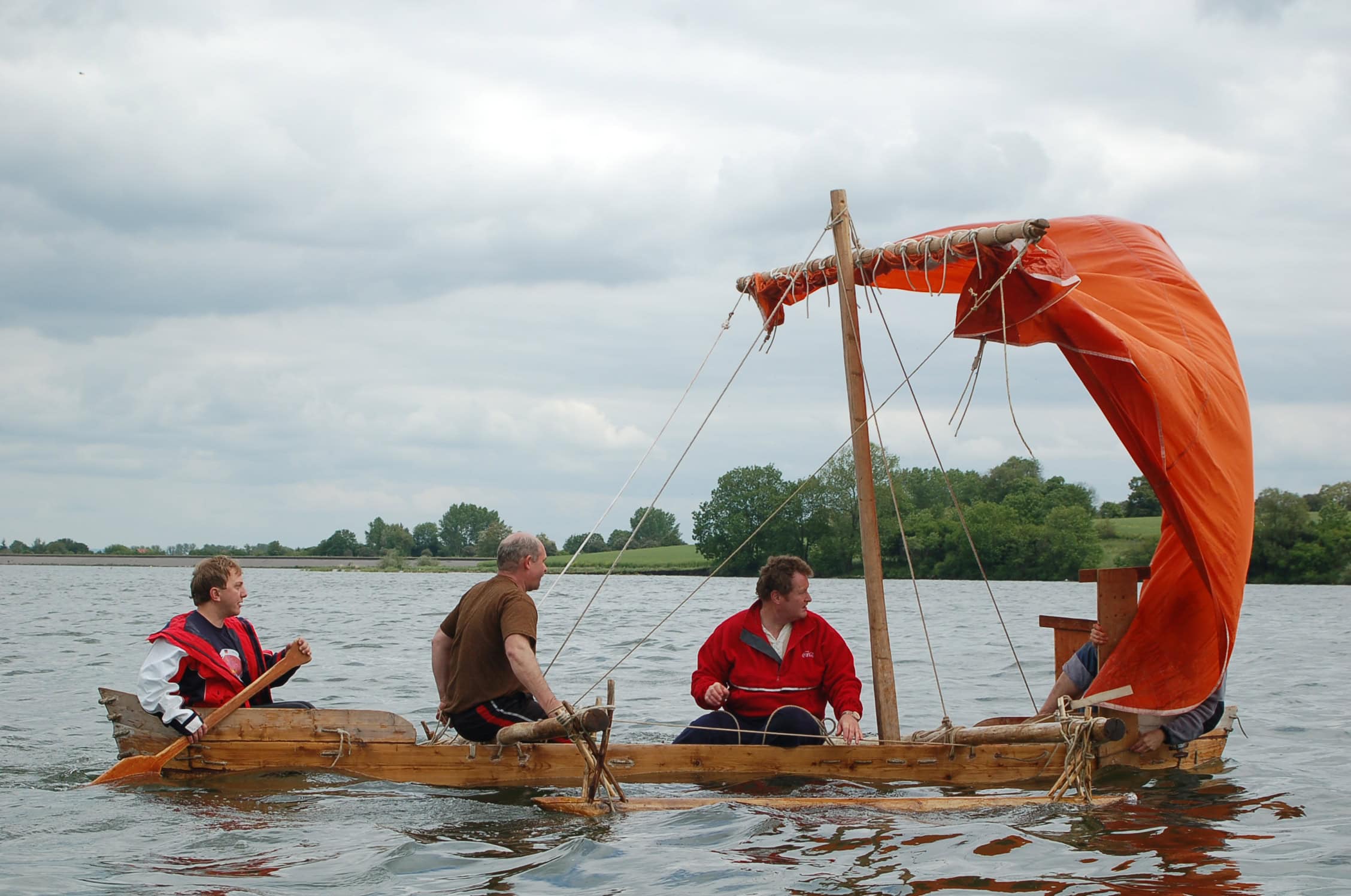
The larger of the two dugout canoes was converted into an extended dugout canoe (pyroge) in 1996 by adding planks. This allowed, for the first time, the practical testing of transitional design forms between simple dugout canoes and more complex boat types.
Both watercraft were:
- equipped with simple reed sails,
- stabilized by double outriggers
- and additionally equipped with simple side swords.
As with the DILMUN projects, the central question here was what influence keel or sideboards could have on the headwind and beam reach capability of early watercraft.
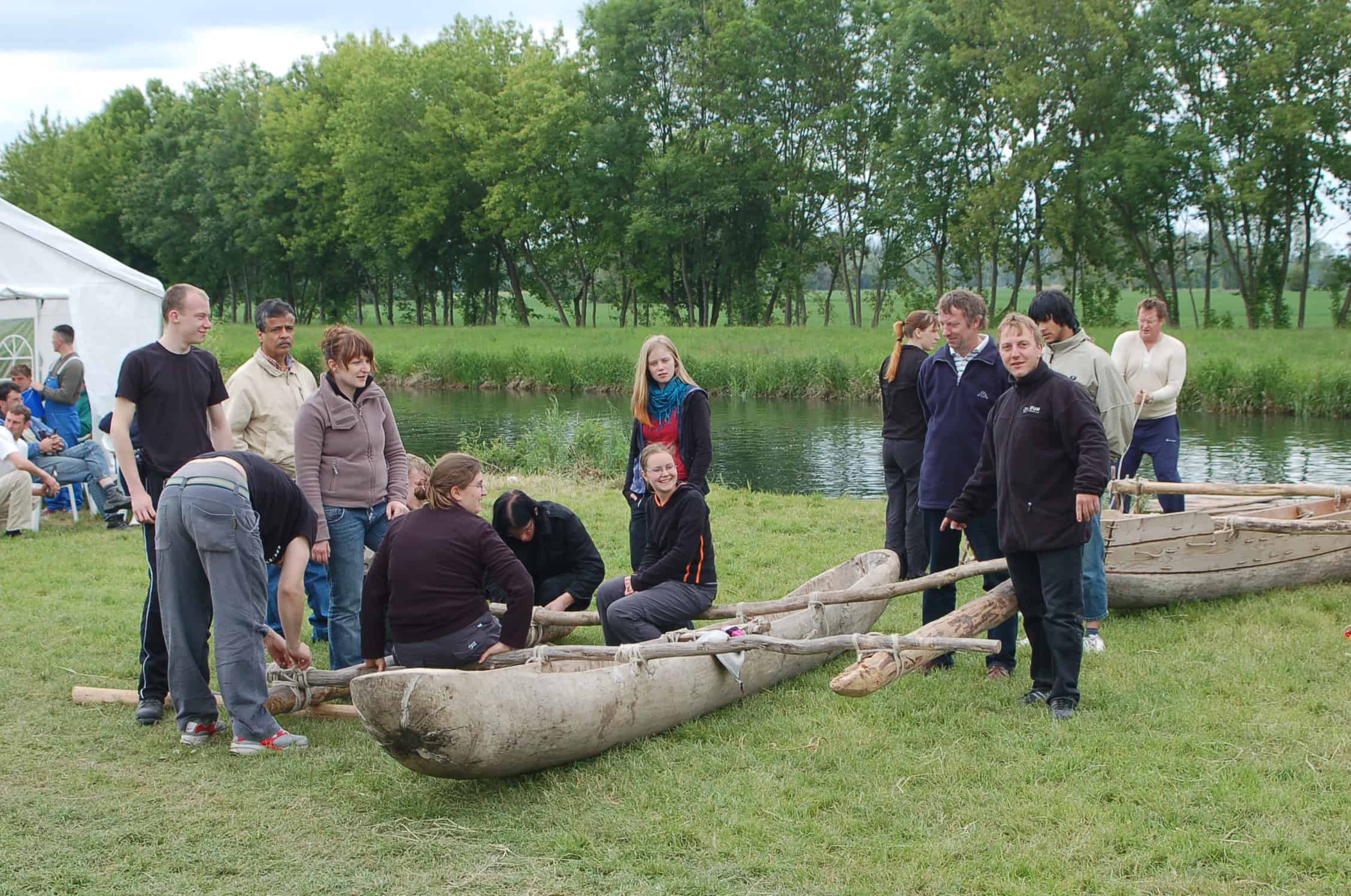
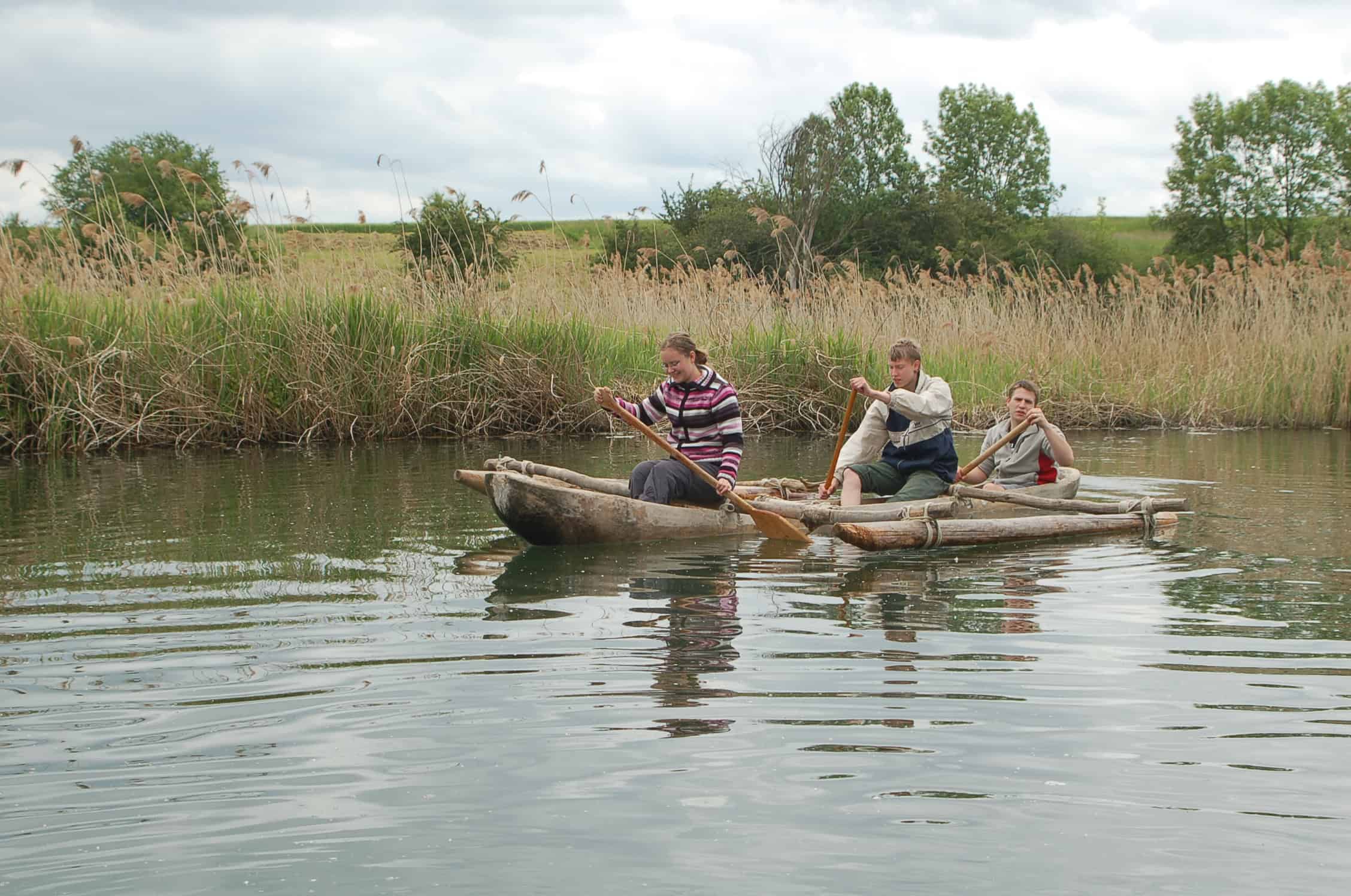
Testing on inland waters and the Baltic Sea
For the sea trials, Görlitz and his students – as before – were quartered at a partner naval school on the Baltic Sea. There, both the simple dugout canoe and the pirogue were systematically tested.
On rivers and inland lakes, both vessels proved to be exceptionally seaworthy. The twin outriggers acted as an effective "keel substitute" and enabled courses up to halfway upwind, even without leeboards.
Years later, the pirogue was additionally equipped with the sail of the DILMUN I. On a large reservoir in Thuringia, stable beam reach courses over the ground could be achieved for the first time with the help of leeboards.
Limits of seaworthiness
Die Ergebnisse auf der Ostsee fielen differenzierter aus. Als relativ kleines Binnenmeer besitzt sie eine geringe Wellenlänge was frühe, offene Wasserfahrzeuge besonders stark beansprucht.
- Even at wind force 3-4, the simple dugout canoe proved to be unseaworthy. The crews capsized regularly.
- The pirogue with the plank attached showed significantly higher stability, but even here, from wind force 5-6, the short, steep waves quickly broke over the railing.
- On larger bodies of water with longer wave intervals, the pirogue would probably have remained more seaworthy, but under Baltic Sea conditions, the open hull could no longer be used safely from wind force 4.
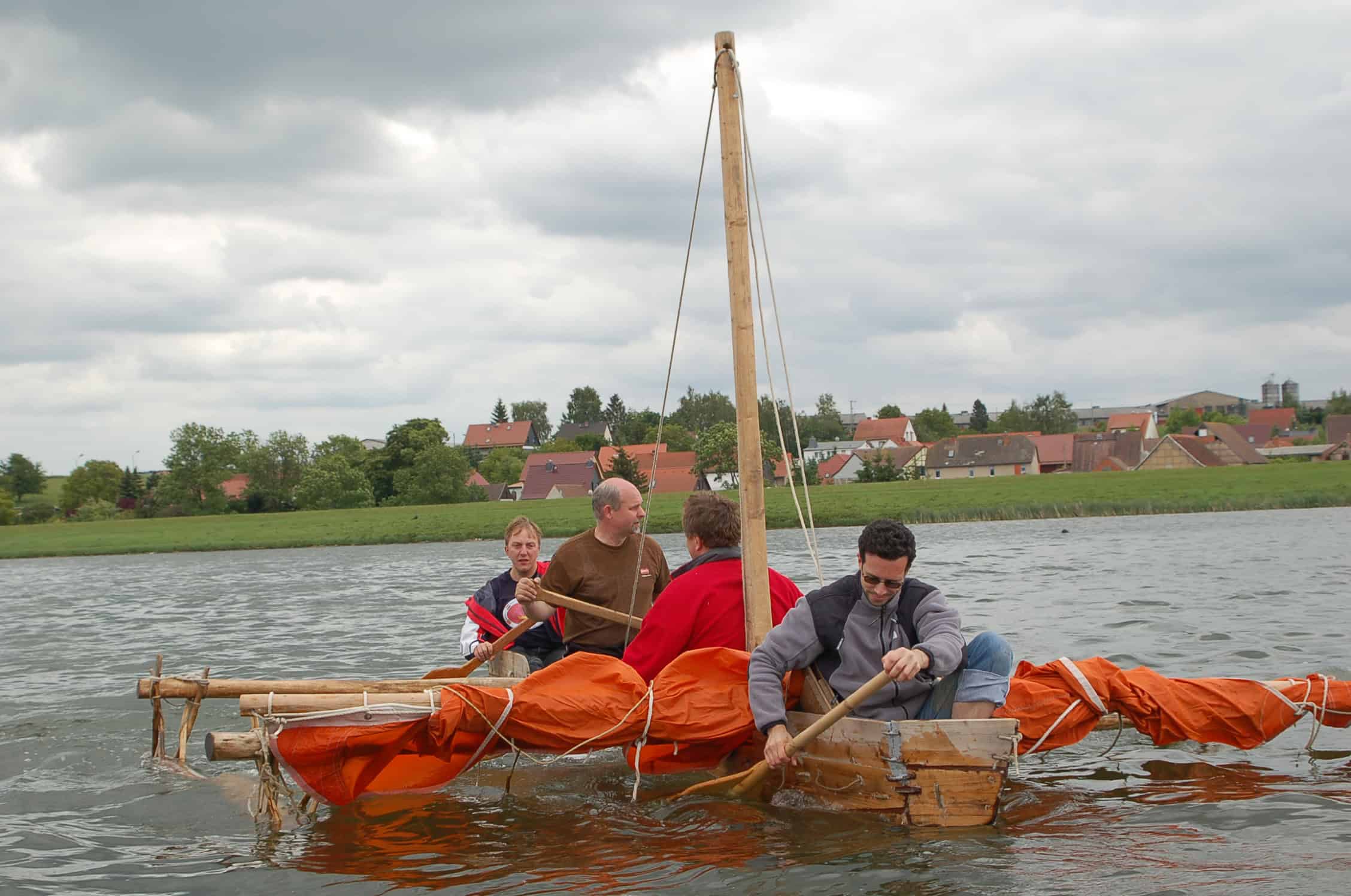
Findings and significance
These experiments made it clear that the seaworthiness of prehistoric watercraft must always be considered in context. Boat type, area, weather, and usage scenario are inextricably linked. This insight became a key experience for all subsequent ABORA missions.
At the same time, the comparisons between rafts, dugout canoes, and pirogues allowed for a deeper understanding of the most important prototypes of early seafaring. While the raft and the dugout canoe are considered symbols of the oldest forms of water travel, the ethnological comparison shows that dugout canoes and pirogues – some even equipped with leeboards – are still in use worldwide today.
The practical advantages and disadvantages of these types of ships provided Görlitz with a wealth of experience, enabling him to assess prehistoric migration and sea routes more realistically.
Educational and scientific perspectives
Alongside the practical experiments, Görlitz's students regularly participated in the "Jugend forscht" (Youth Researches) competitions. They won several state and national prizes – also in connection with the later ABORA-I and ABORA-II expeditions.
After completing their teacher training, Dominique Görlitz and Cornelia Lorenz were transferred to the Leipzig area. At the "Am Breiten Teich" Gymnasium, Görlitz was able to establish a new student working group as early as 1996. Together with former Chemnitz high school students and new students from Borna, construction of ABORA I began just one year later.
With the support of parents, regional companies and the school management, around 18 tons of Chinese silver grass were harvested, dried and bundled into large reed rolls in 1997 near Pegau near Borna in cooperation with an agricultural business.
The transition from a student project to the next major expedition was thus complete. A crucial impetus came once again from Thor Heyerdahl, who supported the project from afar – as well as from the initial offer by TERRA X / ZDF to film the upcoming expedition.
go to DILMUN IV