
back
Early cartography
Mysteries of ancient worldviews
According to conventional wisdom, the history of European cartography only began with the great voyages of discovery in the early modern period. However, several maps from the early 16th century challenge this narrative. They show a world whose geographical accuracy was not actually achieved until centuries later.
Four works in particular are still considered mysteries of cartography today:
- the Waldseemüller map from 1507, which depicts the American double continent and the Pacific Ocean for the first time,
- the Piri Reis map from 1513, which shows the coasts of Antarctica without the Drake Passage,
- the Finaeus map from 1531, which depicts Antarctica almost in its entirety,
- as well as the Gotha marble globe from 1533 with an astonishingly accurate representation of South America and the northeast orientation of the Amazon.
These maps appear surprisingly modern in their precision. Coastlines are largely accurately depicted, long before European sailors had systematically explored these regions. It is particularly puzzling that later maps did not initially improve on this accuracy. In some cases, it took up to 250 years before comparable representations were achieved again. This raises a question that remains unanswered to this day: were these early maps based on older, possibly ancient or even prehistoric sources?
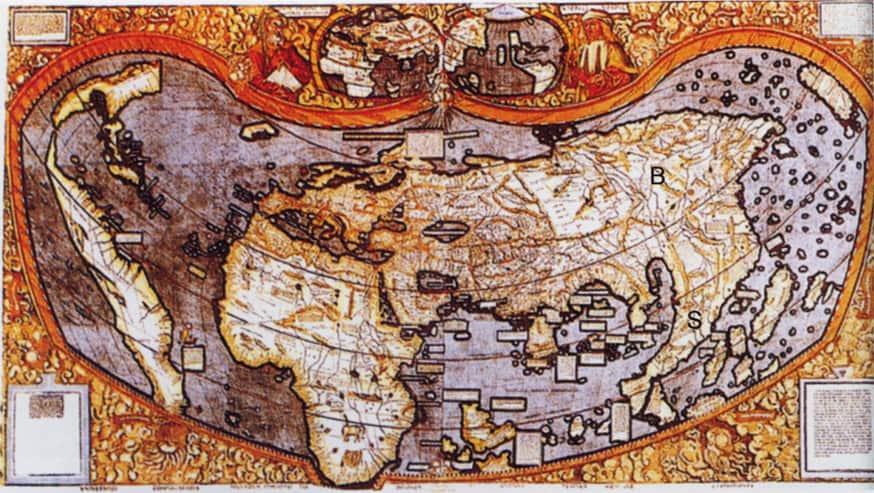
The Waldseemüller map from 1507 shows the American double continent (left) for the first time.
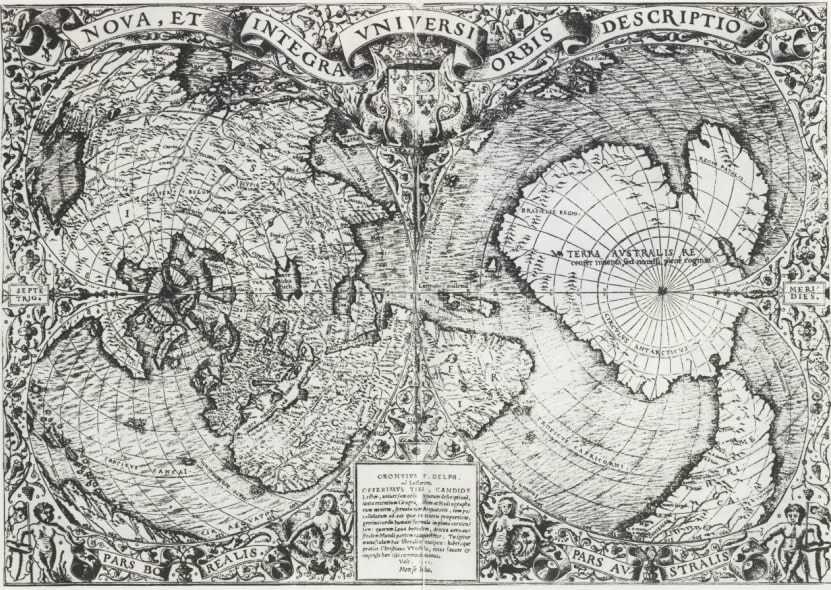
The Finaeus map (1531) shows a complete and, above all, realistic Antarctic for the first time (left).

The Gotha marble globe (1533) shows the exact outlines of Antarctica and South America (left).

The Perí-Reis map from 1513 shows Antarctica for the first time and a bibliography with references to ancient maps (on the right in portrait format).
New approaches to analysis – digital reconstruction and comparison
A key contribution to research into these questions was made by the rediscovery of a previously little-noticed map in the Nikolai Collection of the early 16th century in the State Library of Stuttgart. The map, preserved in the form of globe segments, was photogrammetrically recorded by an interdisciplinary research team led by Dominique Görlitz, digitally assembled, virtually reconstructed into a globe, and additionally transferred into a Mercator projection.
In a joint project with Dr. Andreas Bruschke and with the support of Dr. Jonas Bruschke Virtual reconstructions of all surviving Schöner globes in Germany were also created, including the globe rediscovered in Stuttgart that belonged to a student of Johannes Schöner. The aim of this work was to compare historical coastlines with modern map data using georeferencing for the first time in order to quantitatively record deviations and similarities.
These investigations should be carried out in a second step – in cooperation with Prof. Manfred Buchroithner at TU Dresden – into Dominique Görlitz's habilitation procedure on early cartography. However, the Cheops scandal brought this research project to an abrupt end.
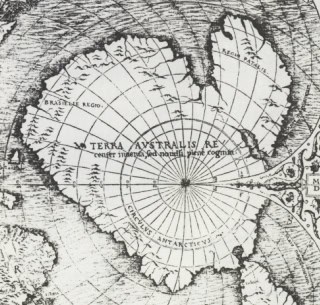
Dieses Bild dürfte es eigentlich nicht geben, denn die Antarktis wurde erst um 1820 durch eine russisch-deutsche Expedition entdeckt. Richtig erkundet wurde sie jedoch erst mit Hilfe der Radiotelemetrie in den 60er Jahren des 20. Jahrhunderts. Vorher wusste man nicht genau, wie die Umrisse der Antarktis exakt aussehen!
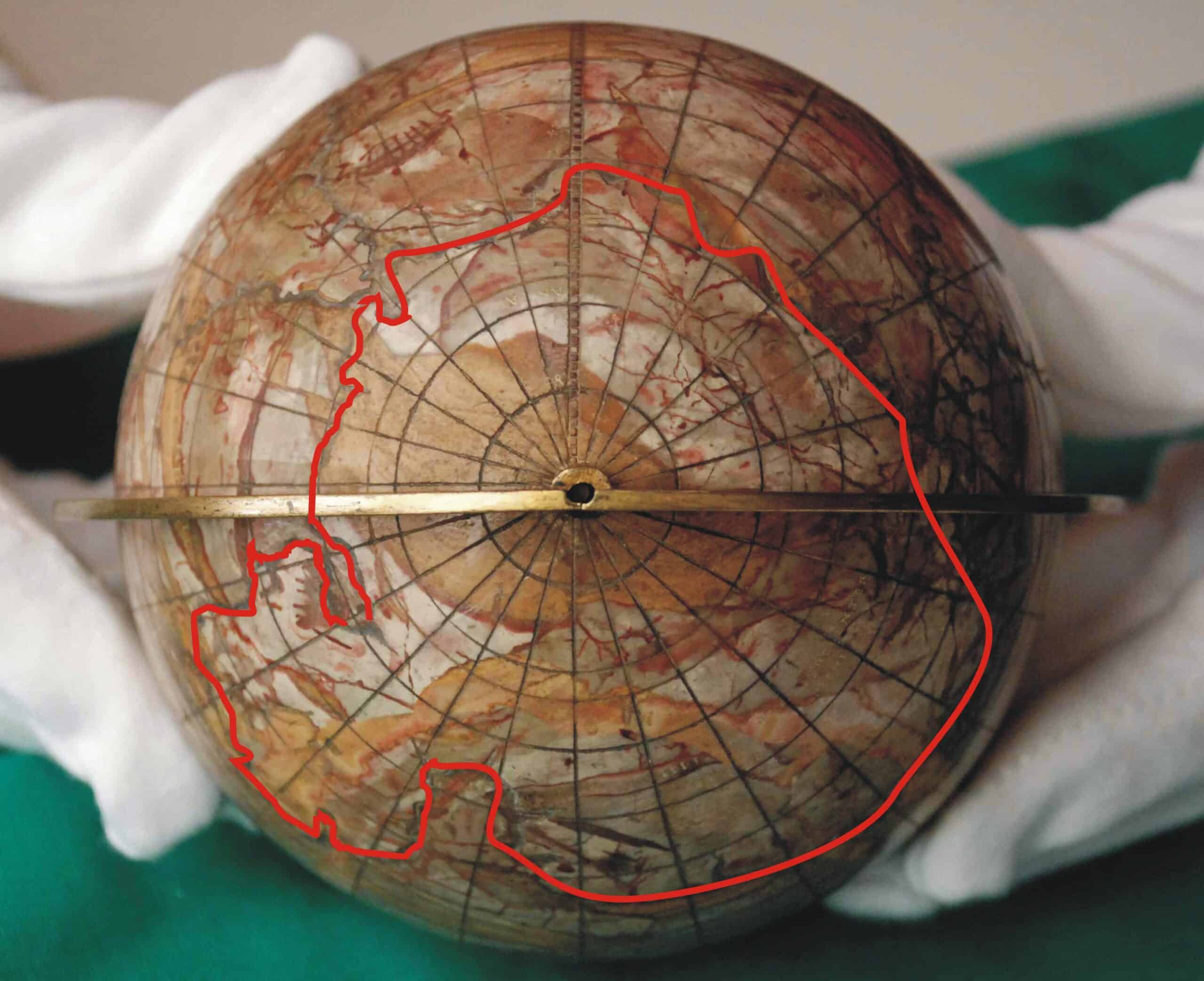
Similar to the Finaeus map, the marble globe also shows a fairly accurate coastline without the Palmer Peninsula. The decisive factor is that, as on the Perí Reis map, Dominique had to rotate the outline by about 30° to the west in order to achieve coverage of the coasts.
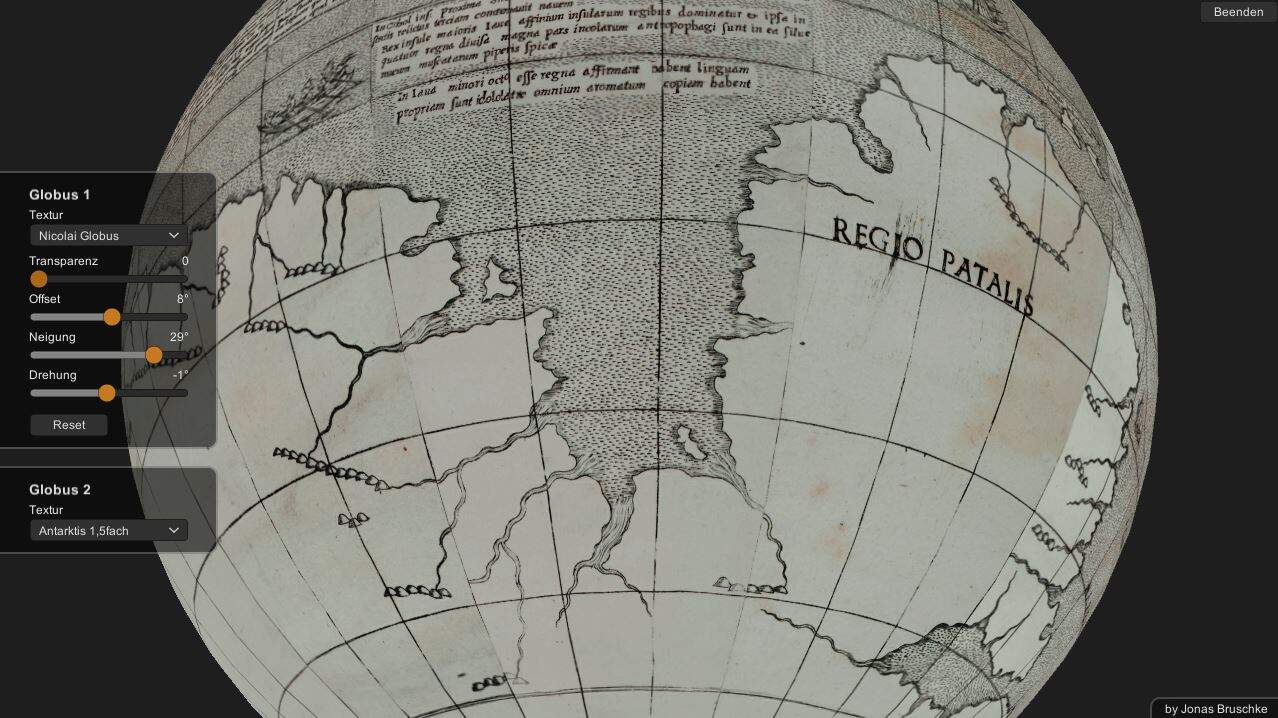
The globe reconstruction from the Nikolai Collection with the Schöner globe reconstruction. The enlargement shows Ross Bay, which was not discovered until 1841. Two relatively large islands are particularly striking. They actually existed. They are both drawn true to form, true to location, almost true to orientation, and, above all, true to proportion! How were cartographers able to achieve this around 1533-1535? Where did they get the exact geodata for this spherical representation?
back