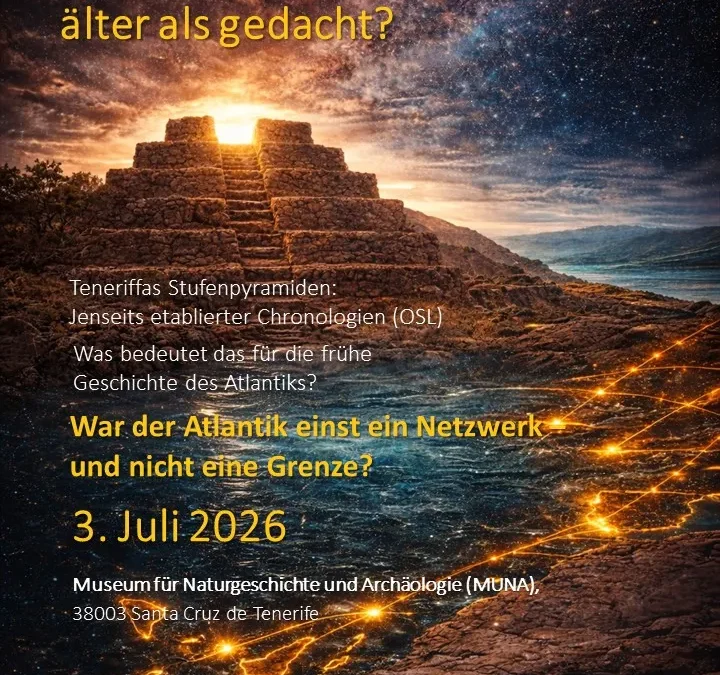
As part of our upcoming OSL conference on July 3rd, 2026, in Santa Cruz de Tenerife, we will present new research findings that may fundamentally reshape our understanding of the settlement and cultural development of the Canary Islands. For the first time, the focus is on systematic OSL dating (Optically Stimulated Luminescence) of dry-stone step structures—particularly at two complexes in the area of Icod de los Vinos on North Tenerife.
The new data suggest that these structures are not of purely historical origin, but instead reflect an older, multi-phase history of use that extends far back into pre-Christian periods. As a result, established models of a relatively late settlement of the islands are increasingly coming under pressure.
These findings raise further questions: If parts of these structures are indeed significantly older, what cultural impulses lay behind their construction? And how might they relate to possible early maritime contacts within the Atlantic region?
Complementary analyses from archaeology, archaeastronomy, and biogeography provide additional indications that the Canary Islands should not be viewed in isolation. Rather, they may have been part of a broader network that enabled long-distance contacts and the exchange of knowledge already in prehistoric times. In this context, previously marginal hypotheses concerning early transatlantic or Mediterranean connections are gaining renewed relevance.
The OSL conference will bring together international experts to critically discuss these new data and place them within a broader scientific framework. The aim is to openly explore the implications of these datings—both for the chronology of island settlement and for our understanding of early maritime cultures.
Are we on the verge of a reassessment of early Atlantic history?
Programm:
11:00 Uhr Begrüßung durch José Carlos Acha Domínguez, Ratsvorsitzender der OAMC (Autonome Organisation der Museen und Zentren Teneriffas)
11:15 Uhr Begrüßung durch den Direktor des Archäologisches Museums und des Kanarischen Instituts für Bioanthropologie, Dr. Conrado Rodríguez-Maffiotte Martin, Teneriffa
11:30 Uhr „Das ABORA-Kanarenprojekt – Schlüssel zum vergessenen Ursprung der Guanchen“ Dr. Dominique Görlitz, Biogeograph, Deutschland, (Englisch)
12:15 Uhr „Typologie der Pyramiden der Kanarischen Inseln“ Gustavo R. Sánchez, Privatforscher, Teneriffa, (Spanisch)
12:45 Uhr „Die Nachtschattengewächse der Kanarischen Inseln und ihre ethnobotanische Bedeutung“, Dr. Jonay Cubas, Botaniker, Tenerife, (Spanisch)
14:15 Uhr „Aktueller Forschungsstand zu den Mumien der Kanarischen Inseln“ Dr. Dominique Görlitz & Dr. Jorge S. Sánchez, Kernphysiker, Spanien (Englisch)
14:00 PM Mittagspause
16:00 PM „Zusammenfassung zur Mumifizierung auf den Kanarischen Inseln“ Conrado Rodríguez-Maffiotte Martin, Bioanthropologe, Tenerife (Englisch?)
16:30 Uhr „OSL-Datierung zweier Pyramiden auf Teneriffa“ Dr. George Polymeris, Kernphysiker, Griechenland & Dr. Jorge S. Sánchez (Englisch)
17:15 Uhr „Stufenbauten auf Teneriffa: Architektur zwischen Landschaft, Himmel und Interpretation im Kontext der Kanarischen Inseln“
Dr. Michael Rappenglück, Vize Präs. der SEAG, Germany, (Englisch)
18:00 PM „Die Bedeutung der OSL-Studie für die Archäologie der Kanarischen Inseln“ Prof. Dr. Carmen del Arco, Archäologe, Teneriffa, (Spanisch)
18:30 Uhr Pause und zur Vorbereitung auf die Gesprächsrunde Diskussion
19:00 Uhr Moderierte Gesprächsrunde mit allen Referenten und dem Publikum
20:00 Uhr Informelles Beisammensein